The license took you six years. The business side? Nobody taught you that part — LLC or sole proprietorship, what an EIN even is, whether $150 a session is greedy or underpriced.
Here’s the whole setup in one place, in the order that saves you money. Most therapists can finish the paperwork side in 60 to 90 days; the website and marketing pieces run in parallel if you start them early enough. Which you should. More on that below.
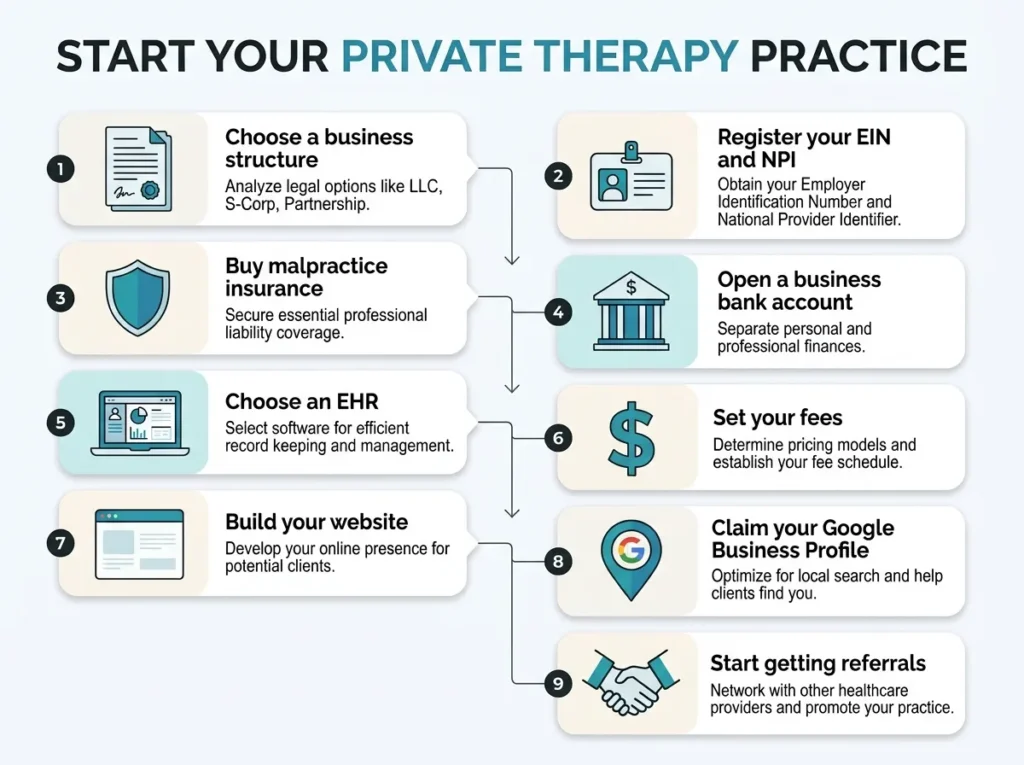
The Short Version: 9 Steps to Open Your Practice
- Pick a business structure — an LLC (or PLLC, depending on your state) for most solo therapists.
- Register for a free EIN with the IRS and an NPI with NPPES.
- Buy malpractice insurance before your first private session.
- Open a business bank account so practice money never mixes with personal.
- Choose an EHR that will sign a Business Associate Agreement.
- Set your fees and your payment policy in writing.
- Build your website while the paperwork processes, not after.
- Claim your Google Business Profile.
- Tell your professional network you’re open — referrals start with colleagues, not ads.
The rest of this guide walks through each stage, with real costs.
Legal Setup: Structure, Registrations, Insurance
Start with the structure, because everything else gets filed under it.
For most solo practitioners, an LLC is the sensible default: it separates your personal assets from the practice’s liabilities and keeps taxes simple. Some states require licensed professionals to form a PLLC or professional corporation instead — California, for one, doesn’t allow standard LLCs for therapists — so check your state board before filing. The SBA’s guide to business structures covers the trade-offs in plain terms, and a one-hour consult with a local accountant is money well spent here.
Then the registrations, both free:
- EIN from the IRS. Takes about ten minutes online. You’ll need it for the bank account and tax filings even as a solo owner.
- NPI through the NPPES registry. Required if you’ll ever bill insurance or provide superbills, which you probably will.
Malpractice insurance isn’t optional, and it’s less painful than you’d fear — solo coverage through providers like CPH & Associates or HPSO typically runs a few hundred dollars a year. Get it before you see anyone privately, even one sliding-scale client.
And open the business bank account the same week the LLC paperwork clears. Commingled funds are the mistake accountants complain about most.
What It Actually Costs to Start
Less than you think, if you resist the office lease.
Expense | Typical range | Skippable at first? |
|---|---|---|
Office space | $500–$2,500/month | Yes — telehealth or hourly sublease |
State filing + registrations | $50–$800 one-time | No |
Malpractice insurance | A few hundred/year | No |
EHR with BAA | $30–$100/month | No |
Website | $12–$40/month DIY, or $3,000–$15,000 custom | No — but scale to budget |
Marketing | $0–$500/month early on | Mostly |
Here’s an opinion we’ll stand behind: skip the lease. A full-time office is the largest fixed cost on this table and the least necessary in year one. Start telehealth-only or sublease a room by the hour from an established group practice, and sign a lease when your calendar — not your optimism — says you need one.
Run lean and a telehealth practice can open its doors for roughly the price of two months’ office rent. 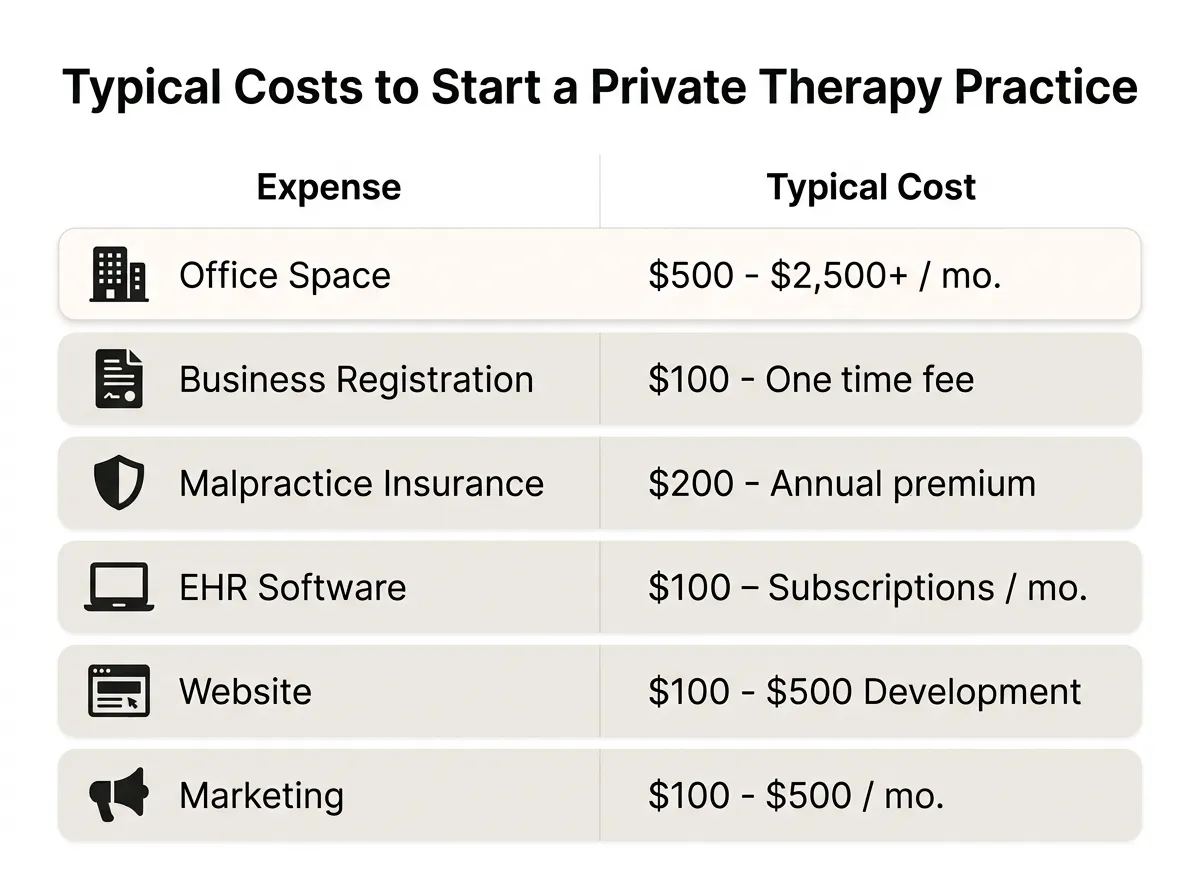
Set Your Fees Like a Business Owner, Not an Apology
Look up what full-fee therapists with your credentials charge in your metro. Price within that range, then put it in writing before anyone asks, because negotiating your worth live on a phone call goes badly for everyone.
The bigger decision is insurance panels versus private pay, and it’s a genuine trade-off:
- Panels fill a calendar faster but pay less per session, add documentation load, and make you wait on reimbursement.
- Private pay pays your full fee and keeps paperwork light, but you carry the whole weight of marketing — clients have to find you, which makes your online presence a business necessity rather than a nice-to-have
Plenty of practices split the difference: a couple of panels for steady flow, private-pay for the rest, superbills for out-of-network clients who want to claim reimbursement themselves. If you hold sliding-scale slots — many therapists do — cap the number in writing so generosity doesn’t quietly become your business model.
Build the Website Before You Think You Need It
The classic sequencing mistake: paperwork first, office second, website “once things settle.” Things never settle, and the website is the piece with the longest lag — Google takes months to trust a new site, and referral sources check you online before they send anyone.
So start it during the paperwork stage. You need five things on day one: who you help, how you work, what it costs, a photo of your face, and an easy way to book. That’s it. Not a blog. Not eight service pages.
One compliance note while you’re choosing tools: your website itself shouldn’t collect health information — keep intake and symptoms inside your EHR, and if your site has a contact form, use one backed by a BAA. We’ve unpacked what the rules actually require (it’s less scary than the forums suggest) in the real rules on HIPAA and therapist websites. Therapeia builds with HIPAA-aware design practices as standard, BAA-compliant forms included.
On budget, the honest math: DIY builders run $12–$40 a month plus your evenings; custom therapist sites typically run $3,000–$15,000. Our middle path is Website in a Week — a custom site, live in 7 days, without the agency-scale invoice. The trade-off we’ll admit to: a 7-day build is intense, and it only works because you arrive prepared (that’s what the strategy call and clarity workbook are for). If you haven’t settled on your niche yet, a well-chosen template is the better first move — our buyer’s guide to therapy website templates covers how to pick one you won’t outgrow in a year.
Marketing That Doesn’t Feel Like Selling
Most new therapists dread this section. Fair. But early-practice marketing is mostly two unglamorous moves:
Claim your Google Business Profile. Free, twenty minutes, and for “therapist near me” searches it does more than any ad you could buy in year one.
Work your professional network. Email every colleague, supervisor, and physician contact you have: here’s who I serve, here’s how to refer. Coffee with two adjacent-niche therapists a month beats any social strategy. Referrals from humans arrive warmer than clicks ever do.
A directory profile can be a third channel — Psychology Today sends real referrals to plenty of practices. Just know what you’re buying: rented visibility on a shared listing, at a fee that only goes up. Build the asset you own alongside it.
And decide who you serve before you write a word of copy. “Adults with anxiety” is a category; “high-achieving professionals whose anxiety looks like overwork” is a practice with a message. Your niche shapes your name, your colors, your About page — the piece most new therapists rush and most clients read closely. We’ve written guides on both: building a therapist brand identity and writing an About page that converts.
Operations: EHR, Intake, and Staying Compliant
Pick the EHR early, because it becomes the spine of the practice — notes, scheduling, billing, telehealth, intake forms all live there. SimplePractice and TherapyNotes are the common picks for solo practices; whichever you choose, confirm in writing that they’ll sign a BAA. No BAA, no deal, whatever the feature list says.
Three habits from day one:
- Online intake before the first session. Secure forms through the EHR, so nobody spends session one on a clipboard.
- Client self-scheduling. Every booking email you don’t send is minutes back, and clients book more readily at 10 p.m. than by phone tag.
- A boundary between website and clinical data. Website handles marketing and first contact; EHR handles everything after. Keep it that clean and most compliance questions answer themselves.
FAQ: Starting a Private Therapy Practice
How long does it take to start a private therapy practice?
Can I start a private practice while still working at an agency?
Do I need an LLC to practice therapy privately?
How much does it cost to start a therapy practice?
How to Launch & Grow a Successful Private Therapy Practice
If you only take one thing from this guide: run the legal checklist top to bottom, but start the website in week one, not month six. It’s the slowest asset to mature and the first thing every referral source checks.
When you’re ready for a site that’s built for how therapy clients actually choose, tell us about your practice through the Website Inquiry Form — we’ll come back with a plan and a custom quote, free.