Therapy Website Templates: How to Pick One That Books Clients
Search “therapy website template” on any big theme marketplace and you’ll mostly find generic wellness themes with a lotus swapped in. Pretty, calm, and built for yoga studios — which is why so many therapists buy one and still get no inquiries.
The template isn’t decoration. It’s the machine that turns a visitor into a consultation. Here’s what separates a therapy website template that books clients from a theme that just sits there, and how to choose yours.
What Makes a Therapy Website Template “Conversion-Ready”?
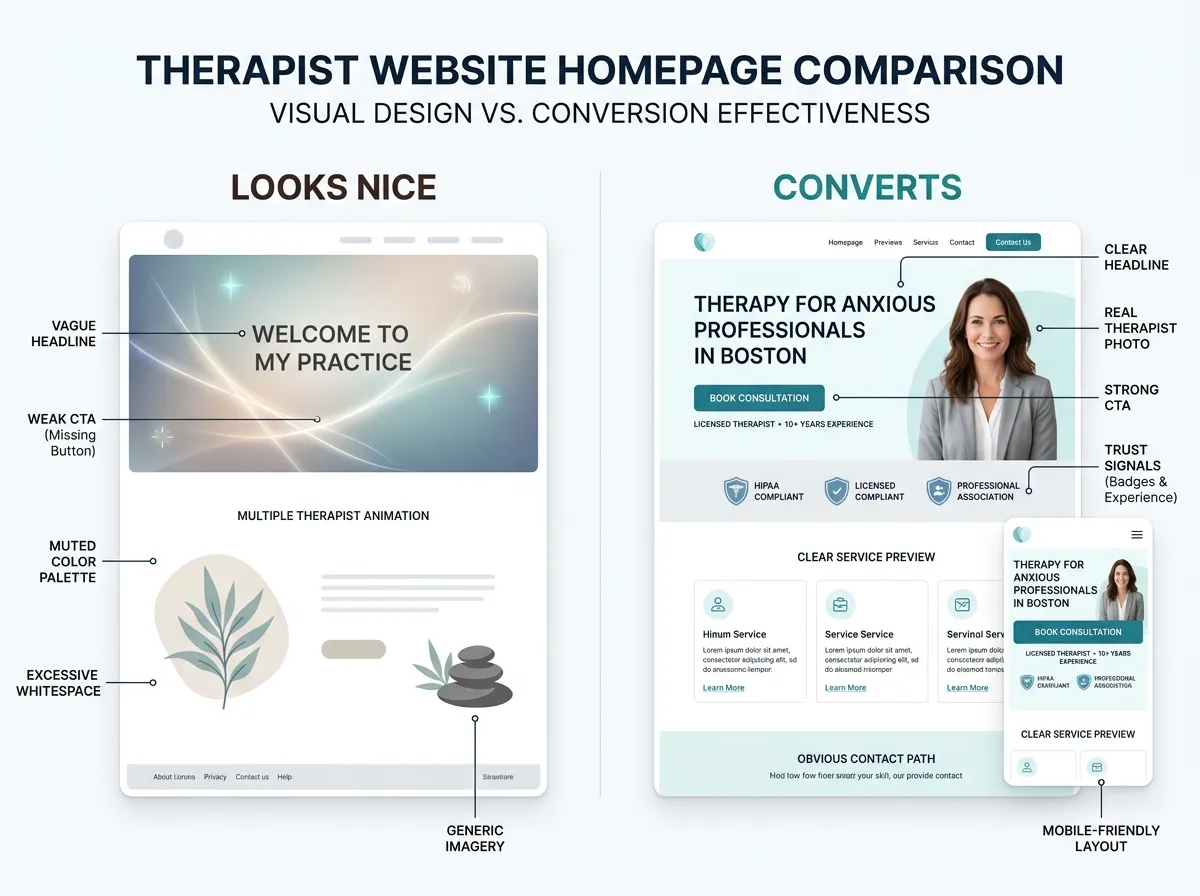
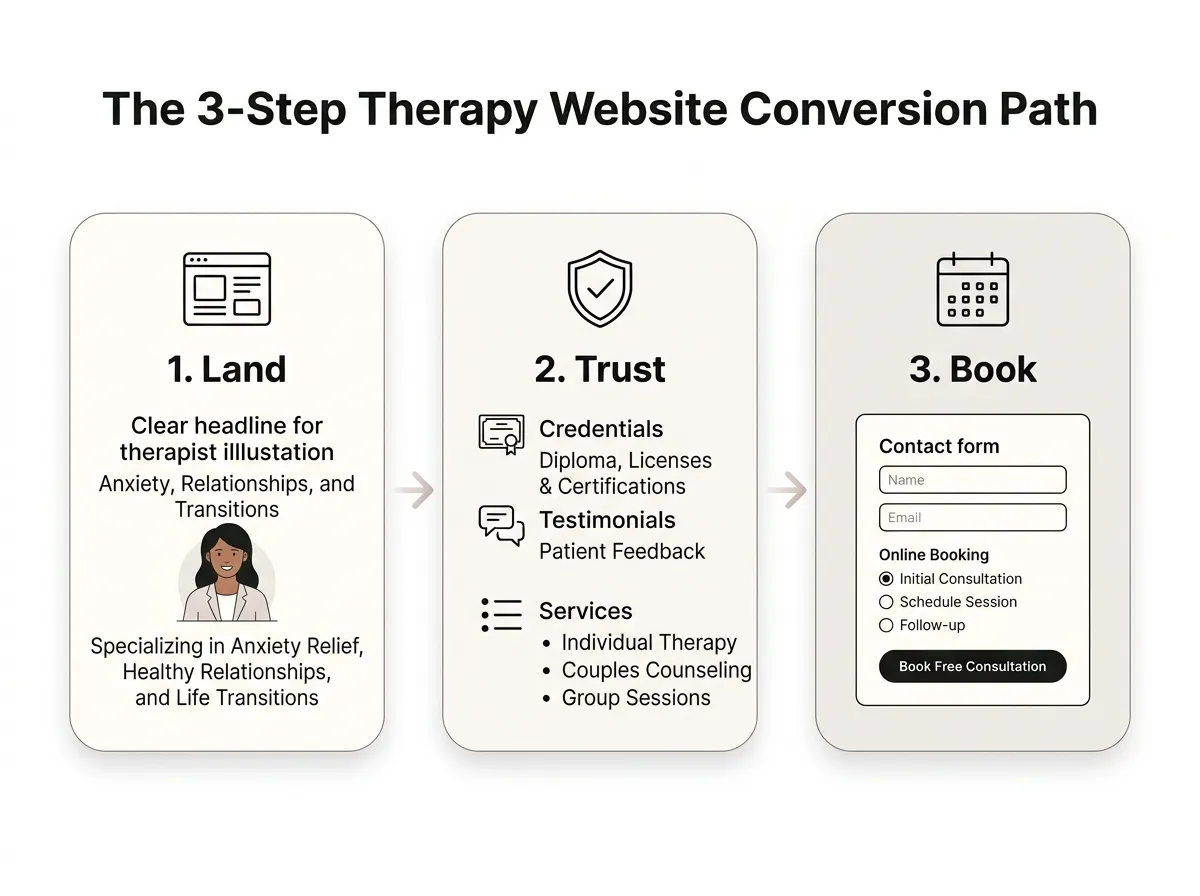
A conversion-ready therapy website template is built around one path: a visitor lands, understands who you help within seconds, sees reasons to trust you, and reaches a booking or contact action without hunting for it. That means a clear headline block, visible credentials and testimonials, and a call to action repeated on every screen.
Compare that to the average theme, where the “path” is a hero image, three stock photos, and a contact link buried in the footer. Both look professional. Only one produces inquiries.
We design every template in our store around that single path — it’s the same conversion architecture from the Therapeia Framework we use on custom builds, packaged at template prices. You can browse the conversion-ready therapist templates to see what the structure looks like in practice.
The Trust Signals a Therapy Template Has to Carry
A therapy client isn’t buying a product; they’re deciding whether to tell a stranger the hardest things they know. The template has to do trust work a bakery site never needs:
- A face, early. Your photo above the fold, not an abstract watercolor. People book people.
- Credentials without a wall of acronyms. License and specialty, readable at a glance.
- Real testimonials, carefully used. Client words carry weight, and therapy has ethical rules around them — the template should make attribution and consent-friendly formats easy.
- Signals of care in the details. SSL, a privacy page, forms that route somewhere secure. A template can scaffold these; it can’t finish them (more on that below).
One line worth internalizing: a pretty theme without a booking path is a brochure. Trust signals open the door; the CTA has to be standing in it.
How to Choose the Right Therapy Website Template
Six checks, in order:
- Niche fit. Was it built for therapy practices, or is it a repainted wellness theme? Look for session-info sections, FAQ blocks, and insurance/fees layouts — signs the designer thought about your actual pages.
- The booking path. Click through the demo pretending you’re an anxious first-time client. Count the clicks to “contact.” More than two is too many.
- Mobile first, really. Most prospective clients will find you on a phone, often late at night. Test the demo on yours before anything else.
- Platform match. The template has to run where you’re comfortable — see the table below.
- Customization ceiling. Can you change colors, fonts, and sections without code? You’ll want the palette and voice you defined in your brand identity to survive the install.
- What support exists. A template with documentation and a human behind it beats a marketplace zip file every time.

Which Platform Should Your Template Run On?
Platform | Best for | Watch out for |
|---|---|---|
WordPress | Full ownership, strongest SEO ceiling, room to grow | Steeper learning curve; you manage updates |
Squarespace | Easiest editing, clean look fast | $16+/month forever; fewer therapy-specific features |
Wix | Low cost, drag-and-drop freedom | Harder to migrate away from later |
Shopify | Practices selling courses, workbooks, digital products | Overkill for a booking-only practice site |
Our store carries templates for all four platforms, delivered within 2 business days. The honest guidance: DIY builders run $12–$40 a month and the real cost is your evenings; WordPress costs more attention up front and pays it back in ownership.
What Therapists Say After Switching
Not vague “success stories” — named clients, from our overall client work. Felicia Hermle of Brave Soul Therapy said her site revamp “exceeded expectations” and singled out the proactive communication. Girlbird left a 5-star review praising the code quality and documentation. Therapists like Chanelle (Mindful Alignment), Kristal (Zen Mind), and Olivia Taylor (Coral Heart Counseling) have shared video testimonials about their builds. The full set lives on our warm remarks page.
What we hear most often is relief, more than compliments on the design. The site stops being the embarrassing thing they don’t link to.
Template, Website in a Week, or Full Custom?
The truthful trade-offs, since this is where most buyers get sold instead of advised:
A template is the fastest, most affordable start, and it will share DNA with other practices using it. If your positioning is clear and your budget is tight, that trade is worth making — you can always rebuild later on the traffic the template earned.
Website in a Week is the middle path: a custom site — strategy call, clarity workbook, brand decisions included — live in 7 days, quote-based. Pick this when a template’s ceiling is the problem but a 6-week project isn’t realistic.
Full custom typically runs $3,000–$15,000 across the industry and makes sense once your practice is established and every element needs to be yours.
And the caveat that applies to all three: no template, and no designer, makes your practice HIPAA-aware. Compliance lives in how your forms, booking, and client communications are set up. Our builds use HIPAA-aware design practices with BAA-compliant forms, and we’ll tell you plainly which parts remain your responsibility.
Therapy Website Template FAQ
Are therapy website templates HIPAA-aware?
How fast can I launch a site from a template?
Can I customize a template to match my brand?
Which platform is best for a therapy website template?
Where to go from here
Run the six checks against any template you’re considering — ours included. If one from the store fits, you’ll have it in 2 business days, and the newsletter takes 10% off any template. If you’re between a template and something custom, get a custom quote through the Website Inquiry Form and we’ll tell you honestly which one your practice needs.