You posted the associate role six weeks ago. Two applicants: one unlicensed, one who ghosted after the first call. Meanwhile the group up the road just added two clinicians, and you’re privately wondering what they know that you don’t.
Usually it’s this: they treat hiring like marketing. Mental health careers are a seller’s market — demand for licensed clinicians keeps outrunning supply — which means candidates choose you, not the reverse. And they research you the same way clients do. Before anyone applies, they’ve read your website. If it only speaks to clients, you’ve built a storefront with no staff entrance.
Hiring Clinicians Is a Website Problem
A group practice website has two audiences: clients deciding whether to book, and clinicians deciding whether to apply. Most practice sites serve only the first. Candidates who find no careers information, no team faces, and no sense of culture quietly apply elsewhere — the practice never learns why the pipeline is dry.
That’s the whole thesis, so let’s be blunt about it. We’ve built 500+ sites for therapists and coaches, and in our audits of group practices the pattern repeats: owners spend on job boards while their own site actively talks candidates out of applying. The job ad gets the click. The website loses the clinician.
What Clinicians Weigh When Choosing Where to Work
Anyone considering their next move in a mental health career is weighing the same short list, whether they say so or not:
- Supervision and growth — who they’ll learn from, and whether hours toward licensure are supported.
- Caseload expectations — the real number, not the recruiting number.
- Pay structure — W-2 or 1099, split or salary, and what’s actually included.
- Flexibility — telehealth options, scheduling control, part-time paths.
- Fit — populations served, modalities respected, values in practice rather than on a poster.
The demand backdrop makes candor cheap and silence expensive: the U.S. Bureau of Labor Statistics projects much faster than average growth for counselors through the decade. Good clinicians have options. If your website answers none of the five questions above, you’re asking them to gamble on an interview to learn what your competitor publishes openly.
Our opinion: publish your supervision structure and pay model, at least in ranges. Practices resist this because it feels exposing. It’s actually a filter that saves everyone’s time — the candidates you lose to transparency were going to leave in year one anyway.
Candidates Google You Before They Apply
Here’s the search sequence behind almost every application: the job ad, then your practice name, then your reviews, then your team page, then — if they’re thorough — the profiles of the clinicians already working for you.
Every stop either builds confidence or burns it. A Google Business Profile with a three-year-old photo and two reviews reads one way. An About page that’s a wall of credentials with no humans in it reads another. Candidates read your client-facing pages as evidence of how you’ll treat them: if the site feels neglected, they assume the practice runs the same way. Our guide to writing an About page clients actually trust applies double for hiring, because candidates read it too.
One page matters more than owners expect: the team page. Real photos, real bios, real specialties. A candidate looking at that page is asking one question — “could I see myself here?” — and stock photography answers it badly.
The Careers Page Most Group Practices Never Build
Fewer than half the group-practice sites we audit have any careers page at all. The ones that do usually have a single line (“We’re always looking for great clinicians!”) and a mailto link. That’s not a careers page; that’s a shrug.
A working one carries five things:
- The realities of the role — caseload range, telehealth split, admin support you provide.
- Supervision and development — named supervisors, licensure-hour support, consultation structure.
- Compensation model — at minimum, the structure; ideally, ranges.
- Who thrives here — honest culture description, including who wouldn’t enjoy it.
- A real application path — a form or a named human, with a stated response time.
Hiring pages are one piece of the larger system we build through our private practice growth service, because recruiting and client acquisition run on the same engine: a site that tells the truth attractively. If the whole site needs the rebuild, not just one page, a custom site in 7 days covers both audiences from day one. 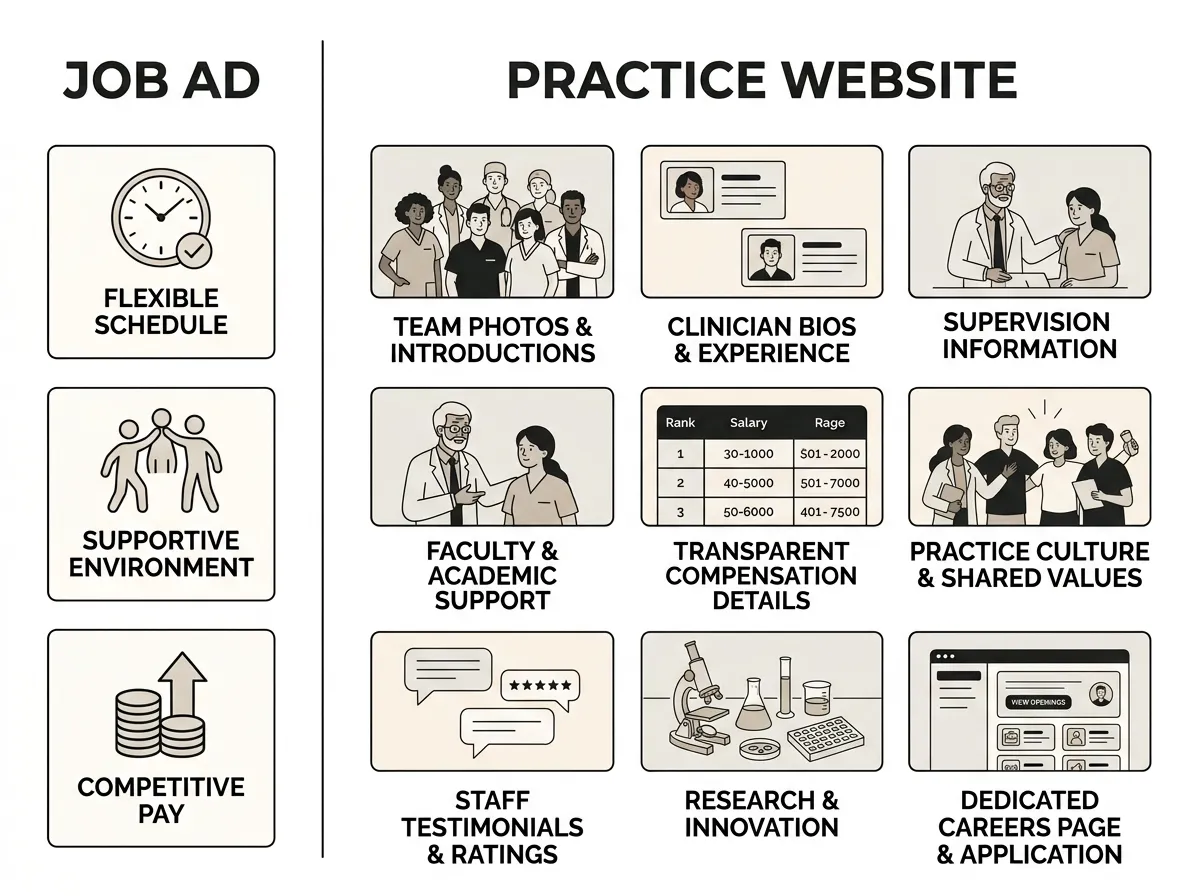
Culture Signals That Separate You From the Agency They’re Leaving
Remember where your best candidates are coming from: agency and community-mental-health settings that burned them out. They’re not hunting for a job; they’re hunting for proof you’re different.
Your website carries that proof or it doesn’t. Specific signals beat slogans: how you talk about caseloads, whether your clinicians’ bios show individual personality or corporate polish, whether your brand identity looks deliberate or defaulted. “Supportive team environment” appears on every practice site in America. “Weekly paid consultation and no evening hours required unless you want them” appears almost nowhere, which is exactly why it works.
Write the sentence only your practice can write. That’s the recruiting strategy.
When You Should Wait on All This
The trade-off, honestly stated: if you’re solo and won’t hire for a year or more, skip the careers page. A “join our team” page that sits empty for two years signals stagnation to candidates and clients alike, and a stale page is worse than none. Recruiting infrastructure earns its keep when hiring is a real 6–12 month intention, not a someday.
What’s worth doing regardless: the team page, the About page, and the reviews. They serve clients today and candidates the day you’re ready.
Frequently Asked Questions
Do group practices really need a careers page?
What should a therapy practice careers page include?
How do clinicians in mental health careers find group practice jobs?
How long does it take to add recruiting pages to an existing site?
Where to Go From Here
Your next great hire will look at your website before they ever look at your offer. If you’re planning to grow this year, send your site through the Website Inquiry Form and tell us you’re hiring — we’ll map what your site says to candidates now, and what it should say instead.