The billing features in a therapy EHR are where the subscription either earns its keep or doesn’t. Four of them do most of the work: superbill generation for out-of-network clients, electronic claims submission through a built-in clearinghouse, ERA (automatic payment posting), and card autopay. Get those four right and billing shrinks from a weekly evening to a few clicks. Here’s what each one actually does, what the fees look like, and which ones your practice genuinely needs.
Superbills: the feature that keeps private-pay clients
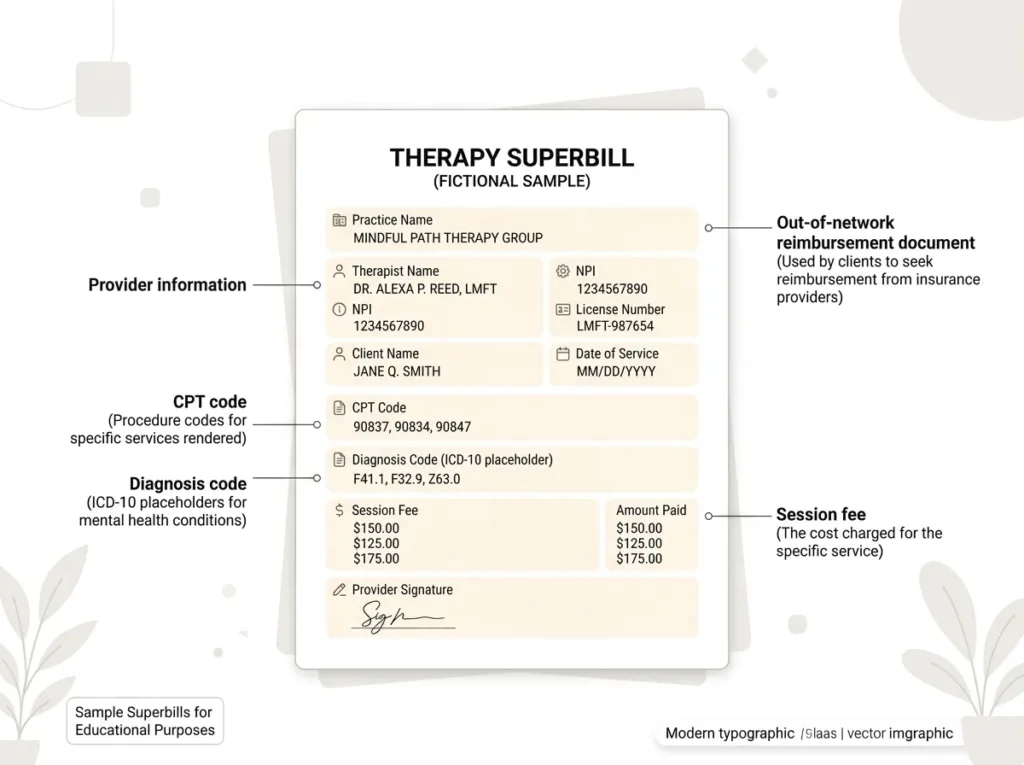
A superbill is an itemized statement of therapy services that clients submit to their insurance company for out-of-network reimbursement. It lists your practice details, license and NPI, diagnosis and CPT codes, session dates, and fees paid — everything an insurer needs to process an out-of-network claim without you billing them directly.
If you run a private-pay practice, this is quietly your most important billing feature. Plenty of prospective clients who “can’t afford private pay” actually can, once they learn their PPO reimburses a chunk of each session after the deductible. A therapist who can say “I’ll give you a monthly superbill; many PPO plans reimburse part of this” closes the gap between their fee and an in-network copay without touching a claim form.
Done by hand, superbills are a monthly chore with real error risk — one wrong code and the client’s claim bounces, and guess who they call. Done by an EHR, they’re generated from session data you already entered and delivered through the client portal automatically. SimplePractice, for example, can create superbills from logged sessions and share them on a schedule; most major therapy EHRs offer some version of this. When you’re comparing systems, check whether superbill generation sits in the base plan or a pricier tier — vendors know exactly how valuable it is.
Claims submission: what a clearinghouse actually does
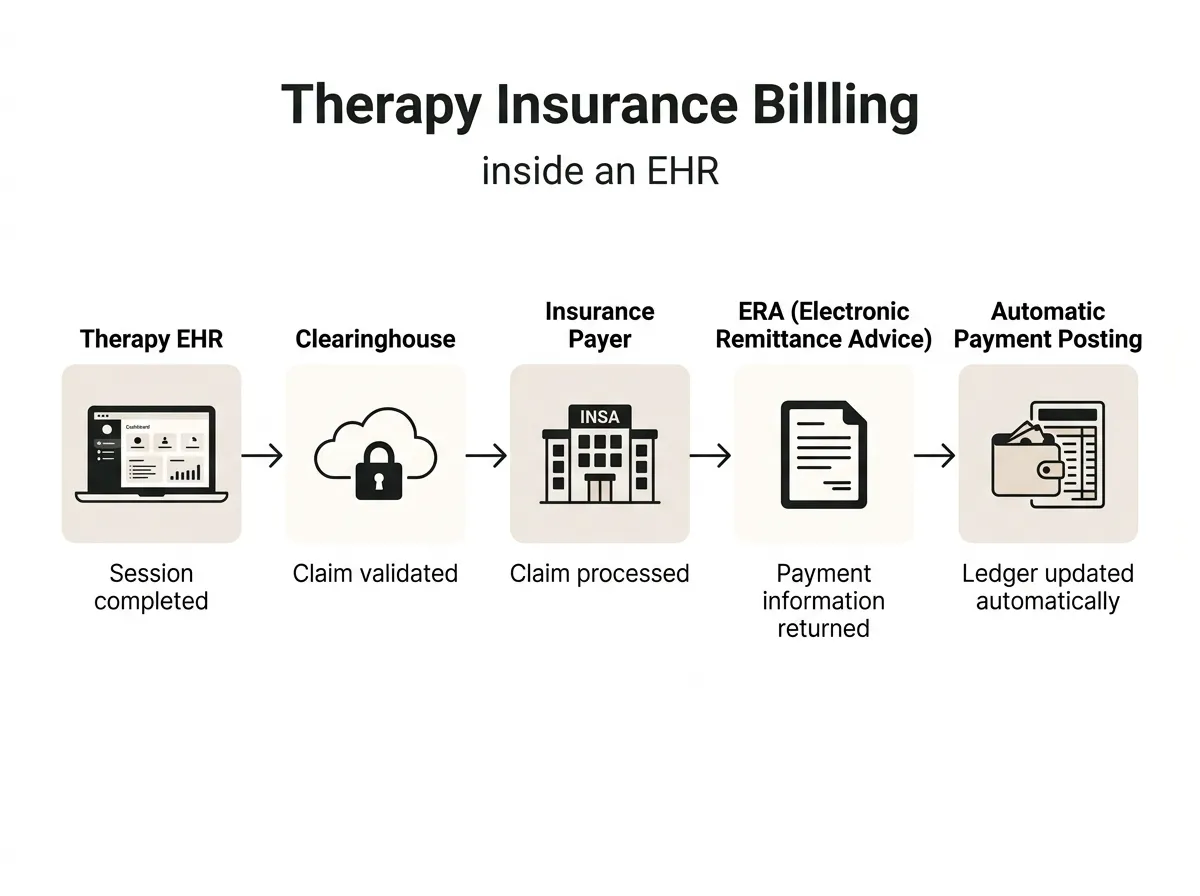
For in-network work, the EHR’s job is getting a clean claim from your session note to the payer without you retyping anything. The middleman is a clearinghouse: a service that takes your electronic claim, scrubs it for formatting errors, routes it to the right insurance company, and reports back rejections before they become month-old mysteries.
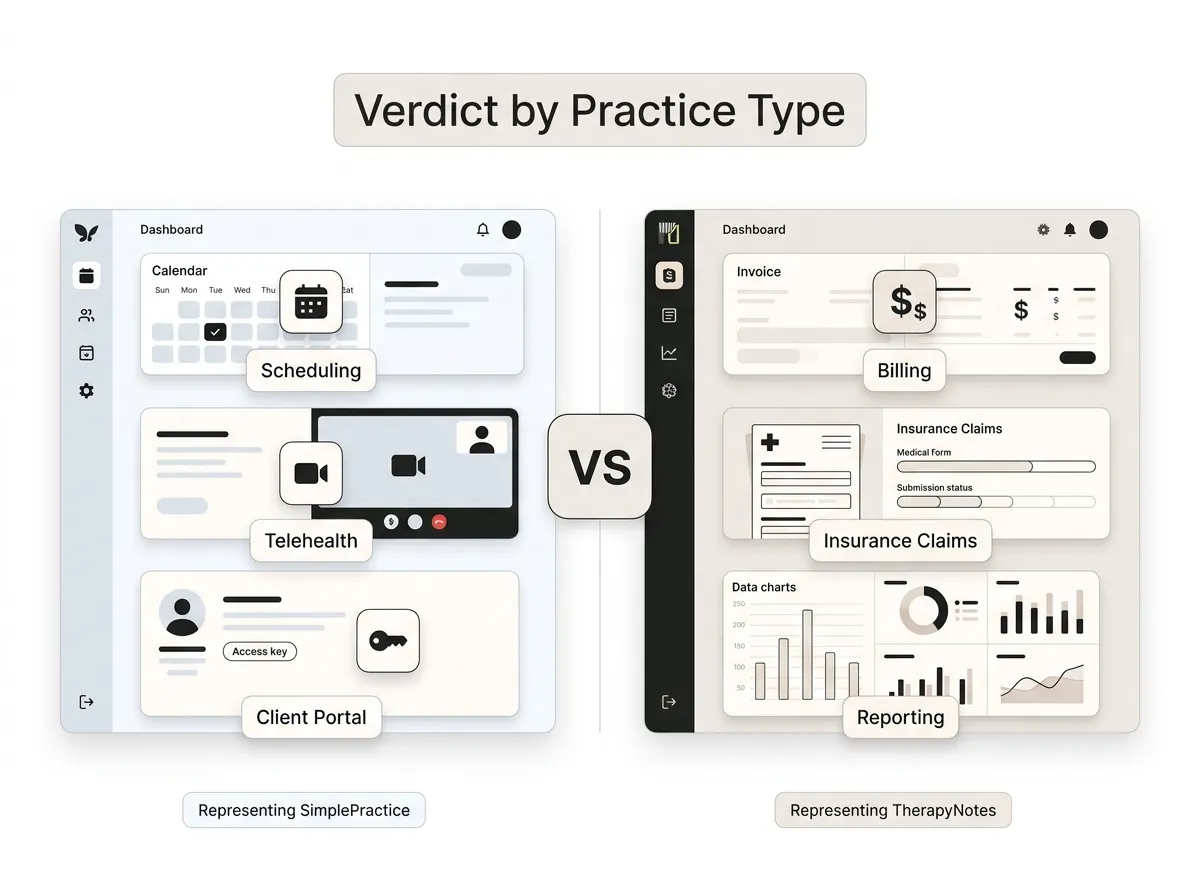
You could buy standalone clearinghouse access and file claims yourself. Almost no solo therapist should. The integrated version means your calendar, notes, and billing share one source of truth: see the client, sign the note, claim goes out. TherapyNotes routes claims through its clearinghouse partner CLAIM.MD; SimplePractice runs claims through its own integrated pipeline with per-claim pricing. The mechanics differ, but the promise is the same — no duplicate data entry, and rejections surface inside the same system where you’ll fix them.
One thing worth checking before you commit: payer enrollment. Some insurance companies require paperwork before an EHR can file to them or send payment reports back, and enrollment timelines vary by payer. Budget a few weeks of setup if you’re panelled with several insurers.
ERA and autopay: where the posting hours actually go
Filing claims is the visible half of insurance billing. The invisible half — reconciling what the payer actually paid against what you billed — is where practices bleed admin hours.
ERA (electronic remittance advice) is the digital version of the paper explanation of benefits. Instead of opening envelopes and typing payment amounts into a spreadsheet, the remittance data lands inside your EHR, matched to the claims it pays, with copays, adjustments, and denials itemized. Good systems then post those payments to client ledgers with a click or two. TherapyNotes charges $0.14 per claim on an ERA; SimplePractice includes ERA payment reports on all its plans. Either way, the cost is trivial next to the hours of manual posting it replaces.
Autopay closes the loop on the client side: card on file, charged after each session or when the ERA reveals the client’s portion. No invoices ignored for six weeks, no awkward “about your balance” conversations at the start of a session — which, for therapists, is a clinical benefit as much as a financial one. Unpaid balances have a way of contaminating the therapeutic relationship. Automation keeps money talk out of the room.
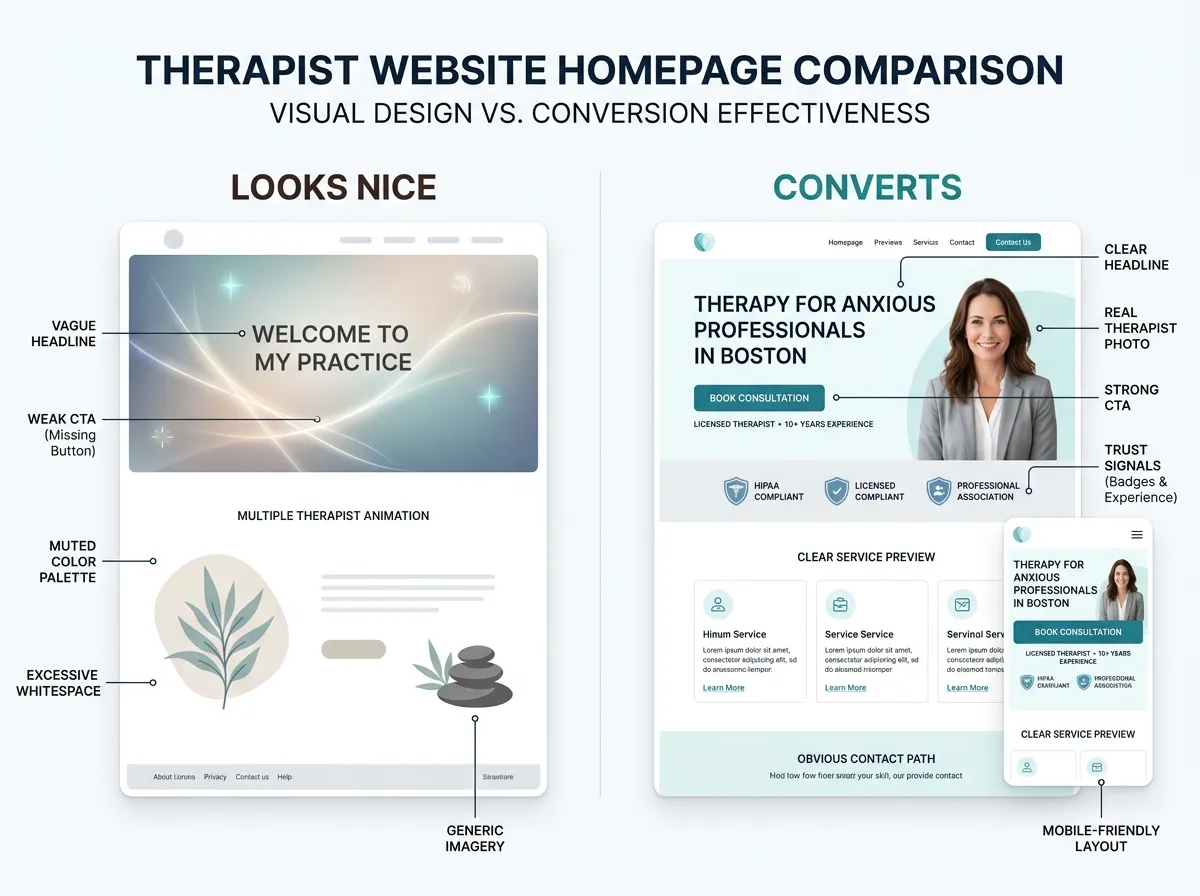
The same logic applies to everything clients touch before a session, too. An EHR portal handles intake and payment, but clients still find and choose you through your website — and the two need to work together. Advising on EHR and booking integrations is part of every private practice website design build we do, because a good booking flow that dumps clients into a clunky handoff undoes itself.
The per-claim fee math (and the fee that actually matters)
Per-claim fees look scary on pricing pages and are, in practice, small money. Verified numbers as of mid-2026, using SimplePractice’s published rates as the worked example:
- SimplePractice Starter: $0.50 per electronic claim
- SimplePractice Essential: 10 claims/month included, then $0.35 each (rates step down at volume)
- SimplePractice Plus: 35 claims/month included, then $0.25 each
- TherapyNotes: $0.14 per claim on an ERA, clearinghouse included
Run the math on a busy insurance caseload — say 100 claims a month. On SimplePractice Plus that’s 35 included plus 65 at $0.25: about $16 a month. Even the worst case (100 claims on Starter at $0.50) is $50 — real, but not decision-driving next to the plan subscription itself and the hours involved.
Now the fee nobody puts in the headline: card processing. SimplePractice’s integrated processing runs 3.15% + $0.30 per transaction. On a $150 private-pay session, that’s about $5 per session — call it $500 a month at 100 sessions, or roughly thirty times the per-claim total in the example above. Our opinion: therapists comparing EHRs obsess over per-claim pennies and shrug at processing percentages, and it should be the other way around, especially for private-pay practices. For subscription costs across the major systems, our therapy EHR costs breakdown does the full-stack math.
Insurance-heavy vs. private-pay: what each practice actually needs
Mostly insurance? Your non-negotiables are integrated claims, ERA with assisted posting, eligibility/status checks, and solid rejection reporting. Secondary-claim handling matters if you see Medicare or older clients with supplemental plans. Superbills barely matter. Weight your comparison toward claim workflow quality — this is where TherapyNotes has built its reputation, and where per-seat pricing earns itself back fast.
Mostly private-pay? Flip the list. You need painless superbills, autopay, good card-processing rates, and a clean client portal. You may never file a claim, so don’t pay a tier premium for claim features — but do confirm superbills are in your tier before signing.
Mixed, or heading from insurance toward private-pay? Buy for where you’re going, not where you are. Migrating EHRs mid-transition is miserable.
And the honest trade-off with all of this automation: it locks you in. Once your notes, ledgers, card-on-file agreements, and payer enrollments live inside one system, switching costs get steep — exporting records is doable, but re-enrolling with payers and re-collecting card authorizations is weeks of friction. Choose deliberately the first time. Our guide to the best EHR systems for therapy practices compares the main contenders feature by feature.
FAQ
What is a superbill in therapy billing?
A superbill is an itemized receipt of therapy services — provider details, NPI, diagnosis and CPT codes, dates, and fees paid — that a client submits to their insurer for out-of-network reimbursement. The therapist stays out of network; the client claims back whatever their plan allows.
Do therapy EHRs charge per claim?
Most charge a small per-claim or per-remittance fee on top of the subscription. As of mid-2026, SimplePractice’s rates run $0.25–$0.50 per claim depending on plan (with monthly allowances on higher tiers), and TherapyNotes charges $0.14 per claim on an ERA. For typical solo caseloads this totals a few dollars to a few tens of dollars monthly.
Is ERA worth setting up for a small practice?
Yes, if you take insurance at all. ERA replaces manually keying every payment from paper EOBs, and posting assistance matches payments to claims for you. The catch is per-payer enrollment paperwork up front — tedious once, then it pays you back every week.
Do private-pay therapists need EHR billing features at all?
They need a different subset: superbill generation, card autopay, and a client portal. Claims tools and eligibility checks can sit unused. That’s a reason to check what each pricing tier includes rather than buying the most billing-capable plan by default.
Where to go from here
Pick the two features that match your payer mix — superbills and autopay for private-pay, claims and ERA for insurance — and judge every EHR demo against those first. And if the other half of your admin problem is a website that doesn’t book clients as smoothly as your EHR bills them, tell us what you’re working with through the website inquiry form. We’ve integrated booking and EHR flows into 500+ therapist sites; a free consultation will tell you quickly whether yours needs work.