How Do You Ensure My Website Remains Hipaa-compliant While Optimizing for SEO
By Therapeia Web Design Editorial Team · Updated 2026-08-05
When it comes to How Do You Ensure My Website Remains HIPAA-compliant While Optimizing for SEO?, hIPAA-compliant website design demands encrypted forms, secure hosting, and signed Business Associate Agreements to protect patient data while supporting SEO rankings. Therapeia Web Design, based in Bolton, Manchester, United Kingdom, employs 50 specialists who build compliant, search-optimized healthcare websites that balance strict privacy regulations with strong organic visibility and patient acquisition performance.
Answering the question of how do you ensure my website remains HIPAA-compliant while optimizing for SEO starts with encrypted forms, secure hosting, and restricted data access without sacrificing search visibility. Therapeia Web Design, a 50-employee agency based in Bolton, Manchester, builds healthcare websites combining SSL/TLS encryption, HIPAA-compliant hosting, and optimized on-page SEO to protect patient data while improving search rankings.
Key Takeaways
- HIPAA-compliant websites protect patient data including names, emails, health records, and IP addresses from unauthorized access.
- Healthcare providers must design websites that prioritize security compliance to avoid regulatory fines and legal penalties.
- Therapeia Web Design’s 50-person team develops fully managed healthcare websites optimized for both HIPAA compliance and search performance.
- Professional HIPAA-compliant web design reduces practice risk by integrating security protocols directly into website architecture and functionality.
What Makes A Website Subject To HIPAA?
A practice website triggers HIPAA obligations the moment it collects, transmits, or stores protected health information. That threshold, not the platform or design style, determines whether federal privacy law applies. Many practice owners assume a simple contact form falls outside HIPAA’s reach — that assumption creates real exposure.
Protected health information (PHI) covers any individually identifiable health data submitted through a website: names paired with symptoms, appointment requests, insurance details, or intake responses. Once a visitor types that information into a form, the site is handling regulated data, not marketing copy.
Does a basic contact form count as PHI?
Generally, a simple “send us a message” field without health details stays outside HIPAA’s scope. Intake forms, symptom checklists, or scheduling tools that request health context cross the line immediately.
Secure online forms matter here because therapists rely on them daily for client intake while staying compliant with regulatory requirements. A HIPAA-compliant site typically includes:
- Encrypted intake and contact forms
- Secure scheduling tools
- Protected data storage and transmission
A well-built, compliant site also builds trust with prospective clients evaluating care options. Therapeia constructs these websites on modern, scalable platforms designed for long-term performance.

How Do You Balance Compliance And SEO?
Compliance and search visibility work together when the underlying architecture supports both from the start. Therapeia Web Design builds every patient-facing form with BAA-compliant contact forms and SSL encryption, protecting sensitive data while satisfying the search engines’ preference for secure, trustworthy sites. Practices don’t have to choose one priority over the other.
Search ranking depends heavily on structured, relevant content. Semantic SEO and schema markup for mental health professionals help Google understand a practice’s specialties, credentials, and service areas without ever touching patient records. That distinction matters: ranking signals come from public-facing content, not protected health information, so growth in traffic never requires exposing client details.
Does local SEO conflict with HIPAA rules?
No. Local SEO for therapists targets geographic. Service-based search terms, working alongside low-friction EHR integrations to strengthen both discoverability and day-to-day efficiency. None of that visibility work touches individual client data.
What technical standards keep a therapy website compliant?
Encryption forms the baseline. Every page and form handling patient data needs SSL/TLS encryption for anything transmitted between browser and server. Beyond encryption, no patient information should reach third-party tools or vendors without a signed Business Associate Agreement in place first.
A compliant, well-optimized therapy site typically includes:
- SSL/TLS encryption across every page and form
- BAA-compliant contact and intake forms
- Schema markup built for mental health search terms
- Local SEO targeting by service and location
- EHR integrations that reduce administrative friction
Built correctly, these elements reinforce each other rather than compete.

Which Safeguards Protect Data Long-term?
Long-term data protection depends on five layers working together: encryption, access control, ongoing audits, accessible design, and connected systems. No single safeguard covers every risk on its own. Practices that treat compliance as a one-time launch task, rather than a continuous process, expose patient data to unnecessary risk months after the website goes live.
Regular security checks and backups keep stored patient data protected as threats evolve. Skipping these updates leaves stored records vulnerable to breaches that a routine audit would have caught. Access restriction matters just as much: only trusted, trained staff should ever view protected health information, and every login should be traceable.
Does accessibility affect HIPAA compliance?
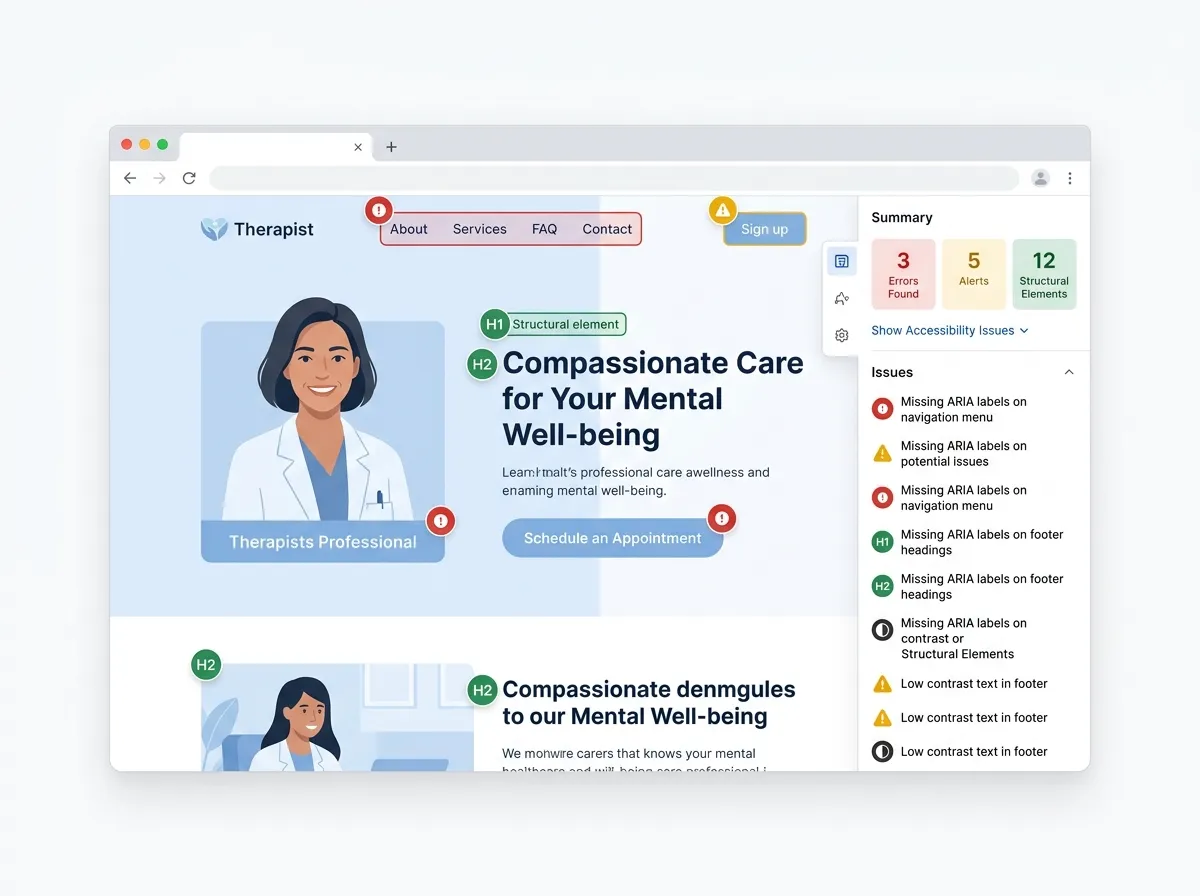
Accessibility and compliance work hand in hand rather than existing as separate goals. Websites built to WCAG 2.1 standards, optimized for neurodiverse patient populations, reduce navigation barriers for people already under stress when seeking care.
How do integrations support security without adding staff burden?
Low-friction EHR integrations keep scheduling and records connected without exposing extra data points. Administrative staff spend less time managing disconnected systems and more time on patient care. Therapeia Web Design backs these safeguards with a 50-person team dedicated to ongoing, compliance-aware maintenance long after launch.
Building a HIPAA-compliant website that ranks in search results requires balancing clinical rigor with technical precision. The intersection of healthcare compliance and SEO demands expertise in both domains—from schema markup that signals authority to security architectures that protect patient data. When these elements align, your practice gains visibility among people actively seeking care while maintaining the trust and confidentiality that define ethical mental health practice. Strategic design transforms compliance from a constraint into a competitive advantage.
FAQ
What triggers HIPAA compliance for a healthcare website?
A website becomes subject to HIPAA the moment it collects, transmits, or stores protected health information, such as names paired with symptoms, appointment requests, or intake responses.
Does a simple contact form require HIPAA compliance?
A basic “send us a message” field without health details stays outside HIPAA’s scope. Intake forms, symptom checklists, or scheduling tools requesting health context cross the line immediately.
Can a HIPAA-compliant website still rank well in search results?
Yes—Therapeia Web Design builds BAA-compliant forms with SSL encryption alongside semantic SEO and schema markup. Ranking signals come from public-facing content, not protected health information.

Facts
- Therapeia Web Design is located in Bolton, Manchester, United Kingdom.
- Therapeia Web Design has 50 employees.