
Local SEO for therapists comes down to three moves: set up your Google Business Profile correctly (including the address-privacy setting most guides skip), build pages that prove you actually serve your city, and keep your practice details consistent everywhere they appear online. That’s the short version. The longer version below covers the part nobody warns therapists about — reviews — and what 90 days of this work can realistically change.
What local SEO means for a practice
Local SEO is the work of making your practice show up when someone nearby searches for help — “therapist near me,” “anxiety counseling in Pasadena,” “couples therapist Denver.” It targets two separate results: the map-based local pack at the top of the page and the standard organic listings below it.
Those two results run on different fuel. The local pack (the map with three business listings under it) pulls mostly from your Google Business Profile: your category, your proximity to the searcher, your reviews. The organic results below it pull from your website: your service pages, your content, your links.
You need both. A profile with no supporting website plateaus fast, and a good website with no profile is invisible on the map. Most therapists we audit have half of one.
Optimizing Your Google Business Profile While Protecting Privacy
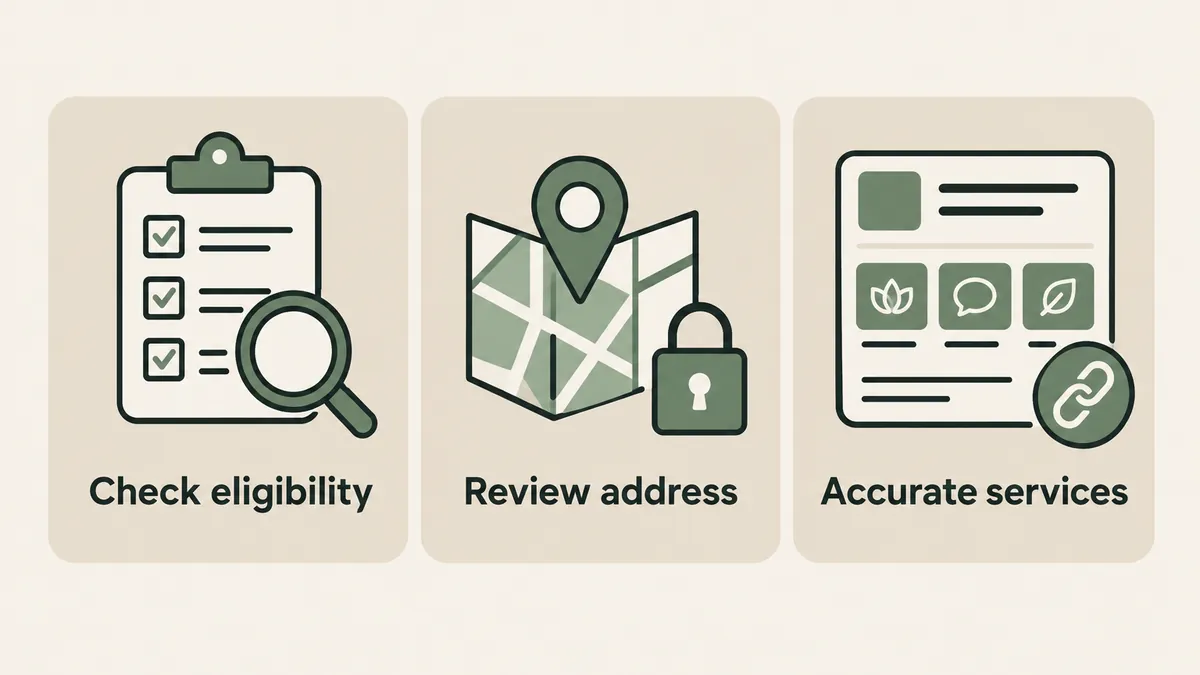
Here’s the nuance that matters for therapists more than almost any other profession: you don’t have to display an address to have a profile.
Google’s rules distinguish between businesses that serve customers at their location and service-area businesses that don’t. If you see clients at a commercial office, list the address. But if you work from a home office or practice mostly by telehealth, Google’s own guidance says to hide the address and define a service area instead — you can list up to 20 cities or postal codes, and Google recommends keeping the whole area within about two hours’ drive of your base.
The setup takes ten minutes. In your profile, edit the location settings, turn off “Show business address to customers,” then add your service areas. Your profile still competes in local results; searchers just see your city and service area rather than your street.
Three more settings worth getting right:
- Category. Pick the most specific primary category available for your license and work — “Psychotherapist” or “Counselor” beats a generic mental-health label. Your primary category is one of the strongest ranking inputs you control.
- Services and description. List actual specialties (EMDR, couples work, teen anxiety), not vague wellness language. Google matches these against queries.
- A real website link. Point the profile at your site’s homepage or your main city-relevant service page, not a directory profile.
One honest caveat: fully virtual practices sit in a gray area. Google’s eligibility guidelines are written around in-person contact with customers, so if you never see anyone face to face, read the current guidelines before you build a profile around telehealth alone. Your website and organic rankings carry more of the load in that case.
The review problem no one warns therapists about
A plumber can text every customer a review link. You can’t — and this is where generic local SEO advice quietly becomes an ethics problem.
The APA’s ethics code (Standard 5.05) says psychologists don’t solicit testimonials from current therapy clients or from anyone vulnerable to undue influence. Counseling and social work codes take a similar line, and a solicited Google review is hard to distinguish from a solicited testimonial. This is business guidance, not legal advice — confirm the specifics with your licensing board before you settle on a review policy.
So what can you do?
- Don’t solicit therapy clients. Not by email, not by a card at the front desk. The awkwardness isn’t worth your license.
- Let organic reviews exist. If a client independently leaves one, you generally aren’t required to remove it (and you usually can’t anyway).
- Respond without confirming anything. Never reply in a way that acknowledges someone was a client — even “thanks for coming in” is a confirmation. A neutral “thank you for the kind words” or a generic policy statement is the ceiling.
- Stop comparing yourself to plumbers. Here’s the good news hiding in all this: every therapist in your city faces the same constraint. Where a roofer needs 80 reviews to compete, therapists routinely rank in the local pack with a handful. The playing field is level; the categories are judged against themselves.
Our opinion, plainly: a therapist chasing review volume is optimizing the one lever they shouldn’t touch. Put that energy into categories, citations, and city pages, where nothing about your license is at stake.
Citations: an afternoon of boring work that pays for months
Citations are mentions of your practice’s name, address (or service area), and phone number across the web. Google cross-references them to decide whether your practice is real and where it operates. Inconsistency — an old office address on one directory, a Google Voice number on another — quietly erodes trust in your listing.
Spend one afternoon on this. Check your name, phone, and website on Psychology Today, your state association directory, your insurance panels’ provider finders, Bing Places, Apple Maps, and Yelp. Yes, we’re the “own your presence, don’t rent it” studio, and we stand by that — but a directory profile working as a citation for your own site is directories doing something genuinely useful for once.
If auditing all of this yourself sounds like a part-time job, that’s essentially what our local SEO for therapists service exists to take off your plate — profile setup, citations, and the monthly upkeep, handled.
Therapist location pages that don’t read like a template
If you serve two or three distinct areas — say an office in Plano and clients across North Dallas — a page per area can work. A page for every suburb in a 50-mile radius does not. Google’s been discounting cookie-cutter location pages for years, and readers can smell “Anxiety Therapy in [CITY]” Mad Libs instantly.
A city page earns its place when it could only have been written about that place: the neighborhoods you actually see clients from, parking or transit notes for your office, the local hospital systems or school districts you coordinate with, telehealth rules for your state. Two or three genuine pages beat fifteen generated ones. Every time.
What 90 days of local SEO realistically moves
No honest answer includes a ranking guarantee, so here’s the honest answer.
- Weeks 1–4: Profile corrections and citation cleanup register quickly. If your profile was miscategorized or half-empty, map visibility can improve within weeks — this is the fastest win in the whole playbook.
- Weeks 5–8: City and service pages get indexed and start appearing for long-tail searches (“EMDR therapist [suburb]”) before the head terms move.
- Weeks 9–12: In smaller metros and suburbs, a local pack appearance for your main terms is realistic. In Chicago or LA, 90 days typically buys movement, not arrival — expect climbing positions and more profile actions (calls, direction requests, site clicks), with the bigger jumps coming in months four to six.
The trade-off nobody selling SEO likes to admit: this is slow, compounding work. If you need clients this month, ads and referral outreach act faster. Local SEO is what makes next year cheaper. If your site has deeper problems dragging everything down, start with our guide to fixing SEO problems on therapist websites — local work built on a broken site underdelivers.
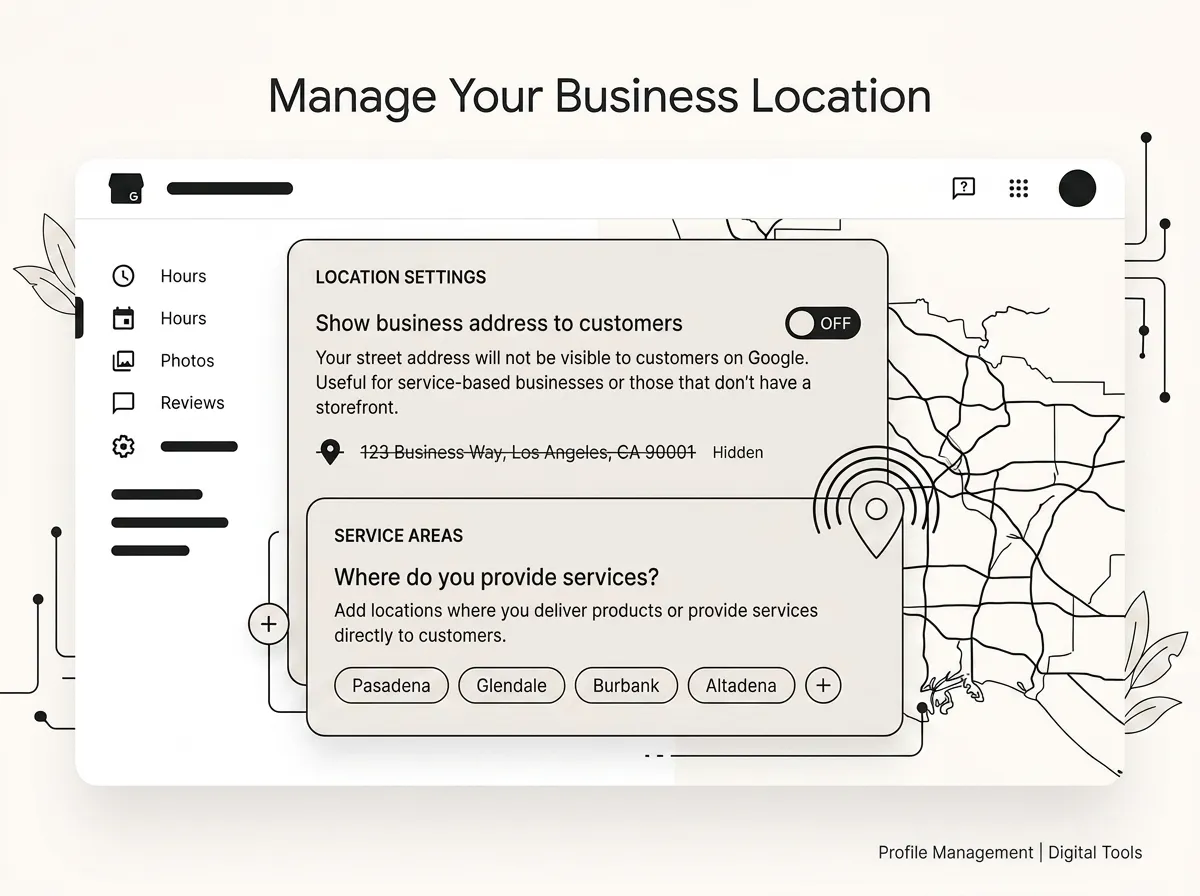
Optimizing Your Google Business Profile While Protecting Privacy
How long does local SEO take for a therapist?
Can I do local SEO without showing my home address?
Can therapists ask clients for Google reviews?
Is a Google Business Profile worth it for an online-only practice?
Where to go from here
Start with the ten-minute wins: fix your profile category, hide the address if you should, and knock out the citation audit this week. The pages and content can follow. And if you’d rather spend those hours with clients, tell us about your practice through the website inquiry form — we’ll map out what local SEO could do for your city specifically, no pressure attached.