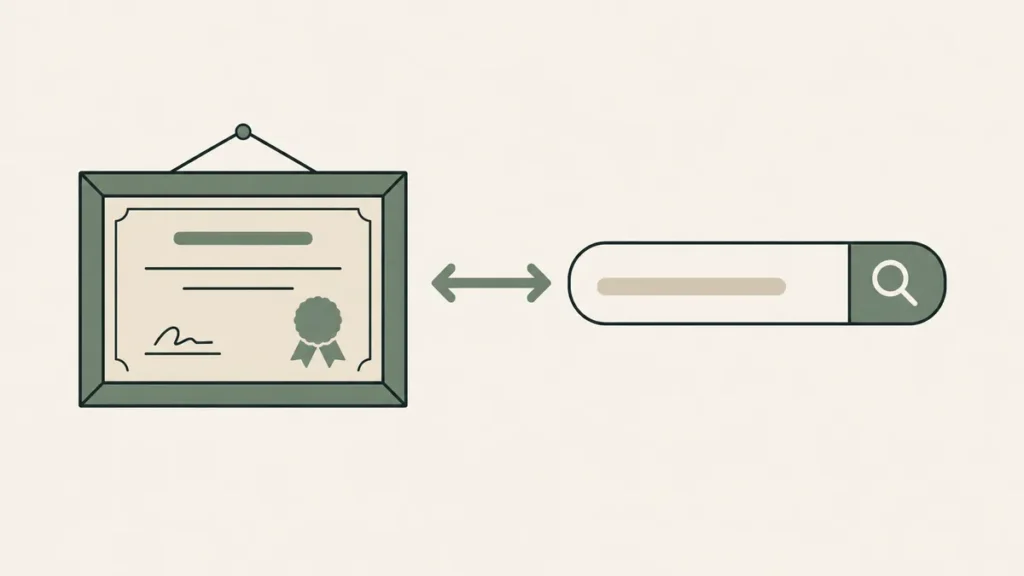
Your license says counselor. Google’s search box mostly says therapist: about 215,000 US searches a month for “therapist near me” against roughly 6,000 for “counselor near me” (Ahrefs, US, September 2026). Most counselor SEO advice never mentions that gap.
The short answer: put the word clients search on each service page, and keep your legal title exact in your credentials line and bio. Below is which word goes where, and what to do first.
What is counselor SEO?
Counselor SEO is the work of helping a licensed counselor’s website and Google Business Profile show up when people nearby search for help. It covers the words on each page, a separate page for every service, accurate license and location details, and a few honest links from other sites.
Mechanically, it’s what any local practice does. The difference is vocabulary. According to the American Counseling Association, LPC, LMHC, LCPC, and LPCC are among the most common titles for professional counselors, and the one you hold depends on your state. Georgia licenses LPCs. Indiana’s title is LMHC, and Ohio and Minnesota use LPCC. Clients don’t know any of that. They know what hurts and what town they live in.
Your license says counselor. Clients mostly search “therapist.”
We pulled US monthly search volumes from Ahrefs on September 30, 2026. These are estimates, so read them for direction.
| Search type | “Therapist” or “therapy” | “Counselor” or “counseling” | Which word leads |
|---|---|---|---|
| General, by person | therapist near me: 215,000 | counselor near me: 6,000 | Therapist, about 36 to 1 |
| General, by service | therapy near me: 207,000 | counseling near me: 35,000 | Therapy, about 6 to 1 |
| Couples, by service | couples therapy near me: 36,000 | couples counseling near me: 10,000 | Therapy, 3.6 to 1 |
| Couples, by person | couples therapist near me: 3,100 | marriage counselor near me: 2,500 | Nearly even |
| Anxiety | anxiety therapist near me: 5,200 | anxiety counseling near me: 1,000 | Therapist, about 5 to 1 |
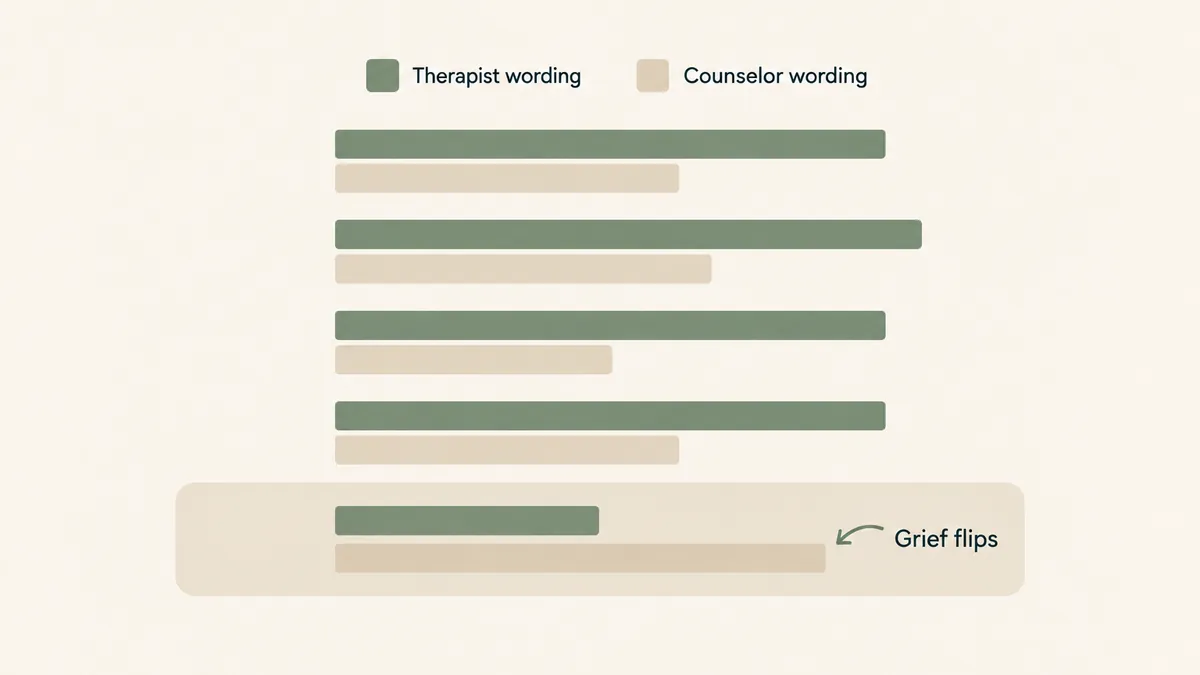
| Grief | grief therapist near me: 800 | grief counseling near me: 16,000 | Counseling, 20 to 1 |
| License wording | No equivalent | mental health counselor near me: 1,600; licensed professional counselor near me: 150 | Few search a license |
Source: Ahrefs, US, September 2026.
Three patterns:
- General searches belong to “therapist” and “therapy.” A homepage that only ever says “counselor” misses the biggest searches in your town.
- It flips by specialty. “Grief counseling near me” gets 16,000 searches and “grief therapist near me” gets 800. “Marriage counselor” is an established phrase too, and it nearly matches “couples therapist.”
- Almost nobody searches your license. “Licensed professional counselor near me” gets about 150 searches a month across the whole country.
One caveat: the anxiety and grief rows compare a person word with a service word, so treat those two ratios as rough. Your own Google Search Console shows what people in your area typed.
Most guides get this wrong in one of two directions. Some tell counselors to swap every “counselor” for “therapist.” Others never raise the question. Choose the word page by page.
Which word goes on which page
Service words follow the client. Title words follow your license.
| Page | Lead with | Example |
|---|---|---|
| Homepage title | Both broad words, plus your city | Therapy and Counseling in Savannah, GA: [Practice Name] |
| Service page | The word that wins for that specialty | Grief Counseling in Savannah |
| Bio and credentials line | Your exact legal title and state | [Your Name], Licensed Professional Counselor (LPC), Georgia |
The homepage title
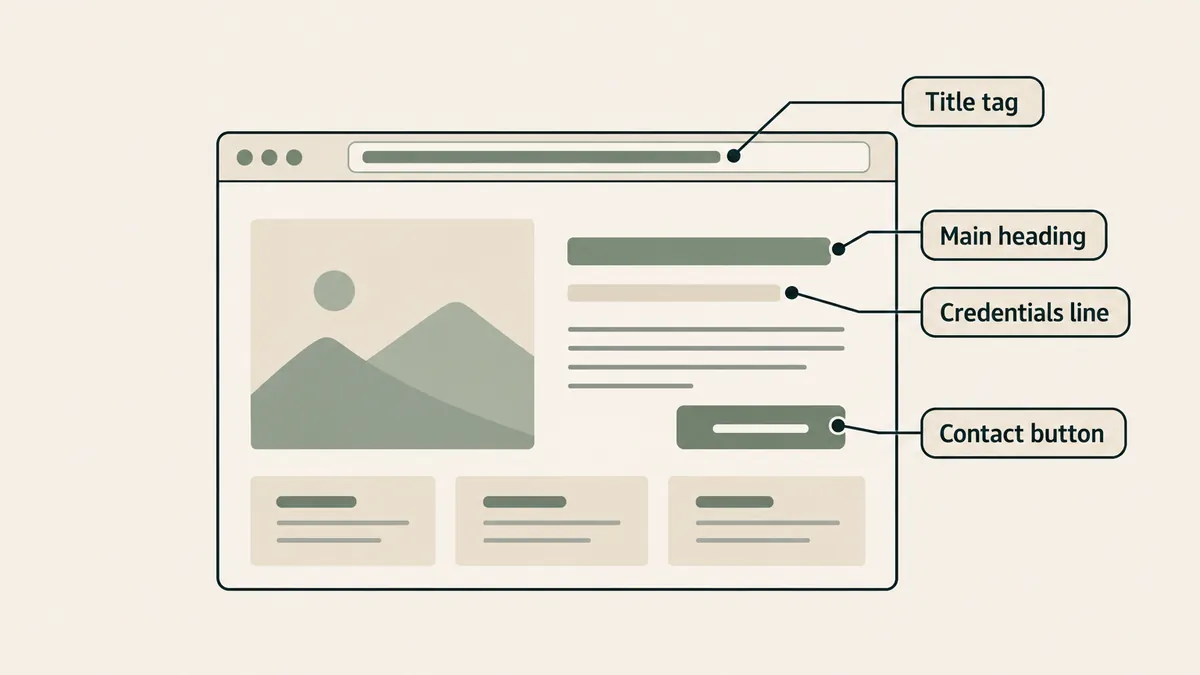
Your homepage title tag has room for both words. Say you’re an LPC in Savannah and the title reads “Home: [Practice Name].” Change it to the example above. Google’s SEO Starter Guide says a good title “accurately describes the contents of the page,” and both words describe what happens in your office.
One caution. Describing your service as therapy is different from giving yourself a title you don’t hold. States regulate professional titles, so check with your board before you call yourself anything that isn’t on your license. This is general marketing information, not legal advice.
Service pages
Each service page takes the word that wins for its specialty. Grief gets “counseling.” Anxiety gets “therapy.” Couples work can carry both: “Couples Therapy and Marriage Counseling in Savannah.” Use the other word once or twice in the body where it reads naturally.
The bio and credentials line
Here accuracy beats search volume. Spell the title out once (“Licensed Mental Health Counselor (LMHC)”), name the state that issued it, and add a plain sentence about who you work with. Our therapist bio examples show how that reads. Don’t repeat the acronym in every heading.
The Google Business Profile category
Google makes you choose from its own list. Third-party copies of that list, checked September 30, 2026, include “Counselor,” “Psychotherapist,” “Mental health service,” “Marriage or relationship counselor,” and “Family counselor.” None is named for a specific license.
Its guidelines say to “choose the fewest number of categories it takes to describe your overall core business.” For a solo LPC or LMHC, “Counselor” matches the license. We can’t tell you from public data which category draws more map views, and we’d be wary of anyone who claims to know. Pick the true one.
SEO for counselors starts with one page per service
A single “Services” page with six bullet points gives Google one weak page to match against six different searches. Six pages give it six real candidates.
Say someone in Fort Wayne searches “grief counseling near me” at 10 p.m., a week after a funeral. A bullet reading “Grief and loss” on a general services page is a poor match for that search. Title a page “Grief Counseling in Fort Wayne,” explain what a first session is like, and you have a good one.
Each service page needs five things:
- A title and main heading in the client’s words, with your city or state.
- Who the page is for, described the way clients describe themselves. “I can’t stop worrying” belongs here. Clinical shorthand doesn’t.
- What the first session looks like, and how fees or insurance work.
- Your credentials line. Once.
- One next step: a phone number or a booking link.
We’ve built 500+ sites for therapists and coaches, and we see the same gap every week in client audits: the specialties live on the Psychology Today profile and are missing from the website.
What are the best SEO keywords for counselors?
The best SEO keywords for counselors pair a service word with a place: “grief counseling in Tulsa,” “anxiety therapy in Tulsa,” “couples counseling near me.” Choose the word clients use for each specialty, which is often “therapy” and sometimes “counseling.” Your license title belongs in your bio, because few people search for it.
You don’t need “near me” on your pages. Google describes distance as “how far each business is from the customer who’s searching,” so your city, state, and address details do that job.
One more thing: “counselor SEO” is a phrase you search. Your clients never will, so keep it off your website.
To see your real keywords, open Search Console and read the Queries list under Performance. It’s free.
Google Business Profile and the local basics
Map results come from Business Profiles, not from websites. Google says “businesses with complete and accurate info are more likely to show up in local search results,” so the basics are mostly about being complete and accurate:
- Claim and verify the profile.
- Use your real-world practice name. Google lets practitioners include a title or degree, so “[Your Name], LPC” is fine. A name padded with search phrases isn’t, and it can get a profile suspended.
- Set your category, hours, phone, and address or service area.
- Match your name, address, and phone everywhere else: site footer, Psychology Today, insurance panels.
A rented mailing address you don’t work from isn’t eligible. Google’s guidelines call that a virtual office.
Reviews can help local ranking, by Google’s own account. We still don’t recommend asking clients for them. Your ethics code and board rules come first. Our local SEO for therapists page covers how we handle the rest.
Licensed in more than one state? Say exactly where
Counseling SEO gets harder the moment telehealth crosses a state line, and this is where we see the riskiest advice.
The Counseling Compact lets a counselor licensed in one member state get a “privilege to practice” in another without a second license. Here’s what the commission’s own site said on September 30, 2026:
- Privileges are being issued. The Compact is live for licensees in nine states: Arkansas, Arizona, Georgia, Indiana, Louisiana, Minnesota, Ohio, Tennessee, and Wyoming.
- Another 29 states and the District of Columbia are still completing the steps. The member map lists 39 states plus D.C., counting Pennsylvania, which the commission says becomes a member later this year.
- To apply, you have to be licensed by one of the live states and live there.
- You need a license or a privilege in the state where the client is located.
- The Compact “does not regulate advertising in the member states.” That’s left to each state’s law.
Say you’re an LPC who lives and practices in Georgia, and a client moves to Tennessee. Both states are live, so you can apply for a Tennessee privilege. Once you hold it, your site can say so plainly: “Licensed Professional Counselor in Georgia. Privilege to practice in Tennessee through the Counseling Compact.”
If that client moves to Florida instead, the answer changes. Florida is on the member list but isn’t one of the nine live states, so the Compact doesn’t cover you there yet.
For your website, that becomes three rules:
- List every state where you hold a license or privilege on your bio, footer, and contact page.
- Build a state page only after you’re authorized there and taking clients there. Give it real content: who can book and how online sessions work.
- Skip city pages in states where you have no office.
Don’t build state pages ahead of your license. A page offering online counseling where you can’t see clients misleads someone who’s looking for help, and no ranking is worth that. Statuses change, so check the commission’s site before you edit your own.
A 90-day order of work for counselor SEO
This order puts the fastest, most certain work first. Budget two to three hours a week. None of it promises a ranking.
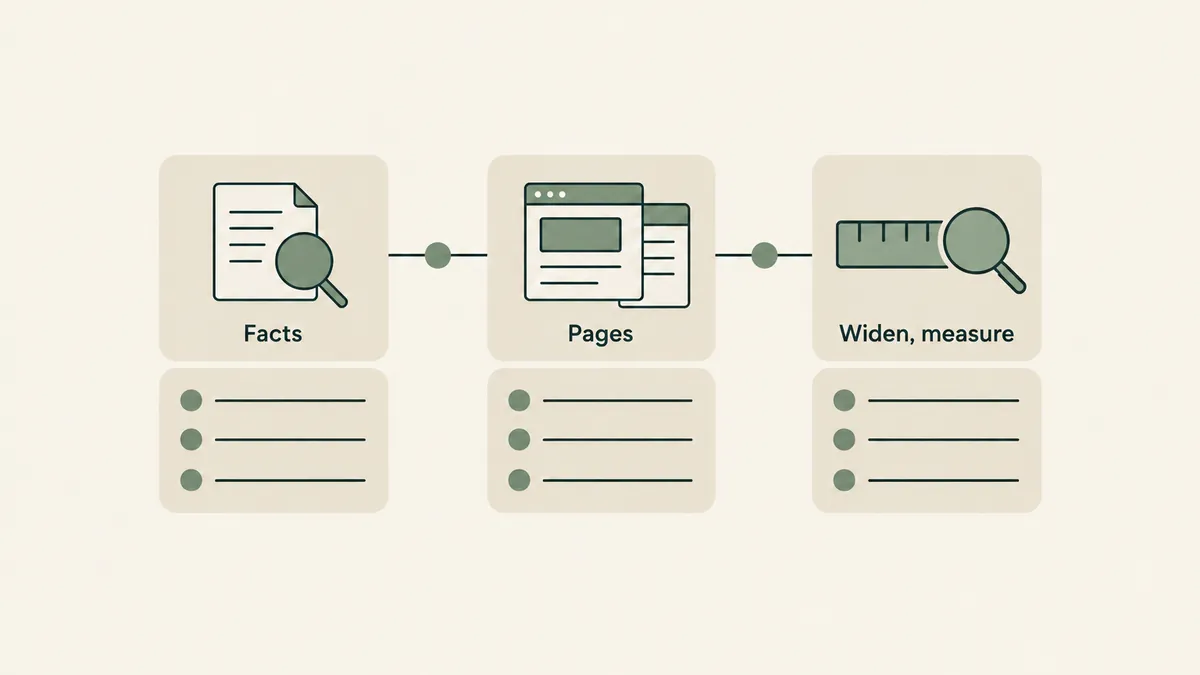
Weeks 1 to 2: get the facts straight
- Verify your site in Google Search Console and submit the sitemap.
- Claim your Business Profile. Set the name, category, hours, and address or service area.
- Rewrite the homepage title so it carries both words and your city.
- Fix the credentials line: exact title, issuing state, same wording in the bio and footer.
- List every service you offer and choose its lead word from the table above.
Month 1: build the pages that match searches
- Write or rewrite your top three service pages, one specialty each.
- Rewrite your bio around who you help, with the legal title stated once.
- Make your name, address, and phone identical on every directory.
If your current site fights you every time you add a page, fix that first. It’s the job of our Website in a Week build: a custom site live in 7 days, quote-based.
Months 2 to 3: widen, then measure
- Finish the remaining service pages.
- Add a “Where I’m licensed” page if you practice across state lines.
- Earn two or three honest links: your state counseling association’s directory, a colleague’s resources page, your graduate program’s alumni listing.
- Open Search Console once a month and adjust titles to match the words people really used.
Say it’s week six and Search Console shows your grief page appearing for “grief counseling” plus your city, but low on the page. That’s normal. The page is matched to the right search. Position moves later, and slower.
If you’d rather hand this list to someone, it’s the work our SEO for therapists service does, for counselors too.
How long does SEO take for a counseling practice?
Google’s own documentation says some changes take effect in a few hours and others can take several months, and that you should generally wait a few weeks before judging a change. For a counseling practice, plan on months of steady work before search becomes a dependable source of inquiries.
That’s from Google’s SEO Starter Guide: “Some changes might take effect in a few hours, others could take several months.”
We won’t give you a tighter number, because it would be a guess about your city and your competitors. Google’s advice on hiring an SEO is blunt here: no one can promise a #1 ranking. There’s more in our piece on SEO timelines for private practices.
Three things to skip
Link packages
Skip them. Google’s spam policies name “buying or selling links for ranking purposes” as link spam. Three links from places that know you are worth more than any bundle sold by the hundred.
City pages for places you don’t serve
Google calls this doorway abuse, and one of its listed examples is “pages targeted at specific regions or cities that funnel users to one page.” Twelve near-identical suburb pages fit that description. One honest page for the town your office is in does not.
Credentials stuffed into every title
“Licensed Professional Counselor LPC | Counselor | Counseling” reads like a form error. Google’s policy on keyword stuffing covers “repeating the same words or phrases so often that it sounds unnatural.” You’d be breaking a rule to chase about 150 searches a month.
When a counselor doesn’t need SEO yet
Here’s the trade-off: SEO is slow, and it isn’t free even when you do it yourself. It costs evenings.
If you’re a solo counselor with a full caseload and a waitlist, fed by referrals and a directory profile, you may not need any of this right now. A well-written Psychology Today profile can carry a practice for a long time (here’s how to write one). We’d rather tell you that than sell you a retainer you don’t need.
The case for starting anyway is ownership. A directory profile is rented visibility: the directory decides how you’re listed and what it costs next year. We compare the two in website vs. therapy directories.
So our recommendation depends on your situation. Full and staying solo: do weeks 1 and 2, then stop. Building a caseload or picking up a second state: do the full 90 days and keep your directory profile running while the site catches up.
Questions counselors ask about SEO
Should I call myself a counselor or a therapist on my website?
Use your exact licensed title in your credentials line and bio. Use the client’s word for your services, which the search data says is often “therapy.” Check your state board’s rules before using any title that isn’t on your license.
Is SEO for mental health practices different from SEO for other local businesses?
The mechanics are the same: clear pages, an accurate Business Profile, a few honest links. The differences are professional. You shouldn’t solicit client reviews, and your licensure details have to be exact.
Can I do counselor SEO myself?
Yes. The 90-day order above is written for a counselor working alone. Hiring help makes sense when time is the constraint or the site itself needs rebuilding.
Do I need a blog for counseling SEO?
Not at first. Service pages and your Business Profile come before any blog post. Later, one useful post a month widens the searches you can show up for.
Can I build a page for a state while my Compact privilege is pending?
Wait until the privilege is issued. The Counseling Compact’s site says you can start practicing once your privilege number appears on your dashboard, and it leaves advertising rules to each state.
Counselor SEO comes down to two kinds of accuracy: the client’s word on the page they’ll land on, and your legal title where it counts. If you’d like a second pair of eyes on which pages your practice needs, you can get a custom quote through the Website Inquiry Form. The consultation is free, and if the honest answer is “keep your directory profile and fix two titles,” that’s what we’ll tell you.