Psychology Today costs $29.95 a month with no contract, and by its own figures puts around 971,000 people a week in front of the US directory. Most therapists listed there get profile views. Far fewer get contacts, and the gap usually sits in the profile rather than the therapist: a photo cropped at the chin, a statement that opens with a licence, fourteen specialties ticked, a fee left blank.
This guide works through the profile the way a prospective client does, field by field, with the character limits in the current editor, an illustrative before-and-after statement, and a straight answer to the question every therapist eventually asks: whether you can rank higher on Psychology Today. It ends where the profile’s job ends and your own website’s begins, because the two do different work and most practices need both.
One note on the limits: they’re from the US editor as of mid-2026. Each box shows a live counter. When this page and your counter disagree, the counter wins.
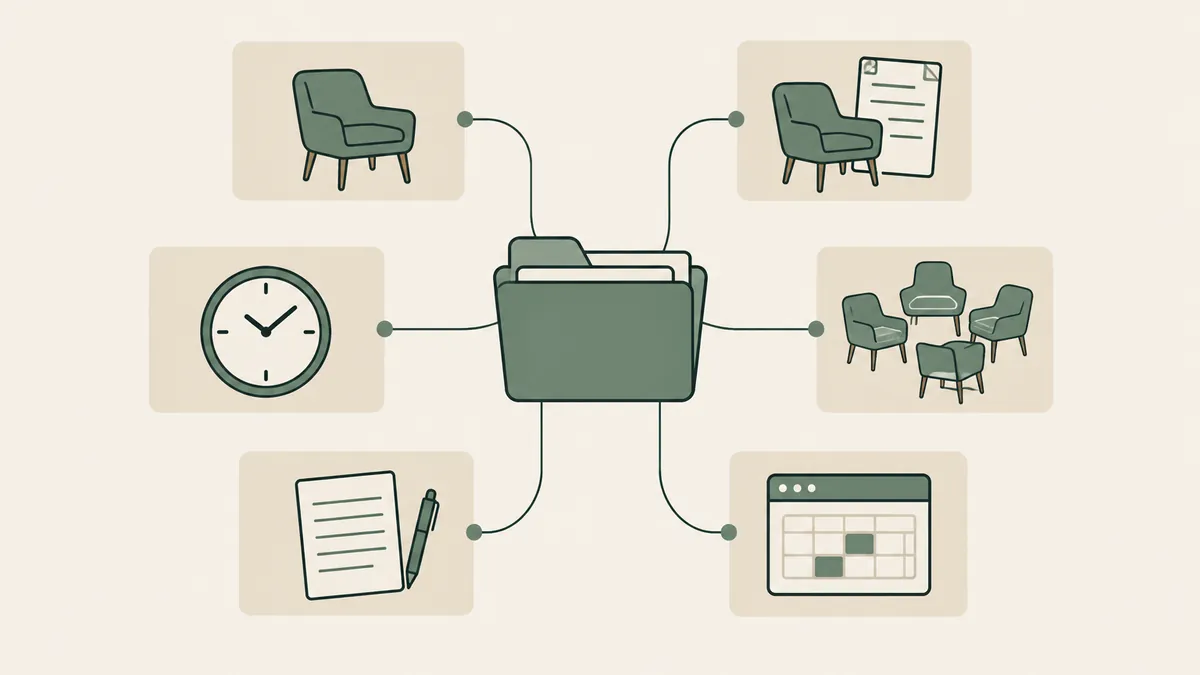
How a Psychology Today profile turns into a client
There are three stages, and each has its own number in your account, since Psychology Today tracks profile views, calls and emails.
- The search card. A circle photo, your name and credentials, the first line of your statement, your starred specialties, and small flags for fee and insurance. This wins or loses the click.
- The profile page. Statement, checkboxes, fees, location, video, endorsements. This wins or loses the contact.
- The contact. An email through Psychology Today, a call to your protected number, or a click on your website link.
Optimising a profile means raising two ratios: clicks per card impression, and contacts per profile view. Every field below serves one of those, and knowing which one tells you what to fix when a number is low.
Can you rank higher on Psychology Today?
Not in the way the phrase implies. Psychology Today doesn’t publish how it orders profiles within an area, and therapists consistently report that the order changes from one search to the next; Headway’s guide describes it as random within a geographic area. There is no field to fill in and no upgrade to buy that fixes you at the top of the list.
What you do control:
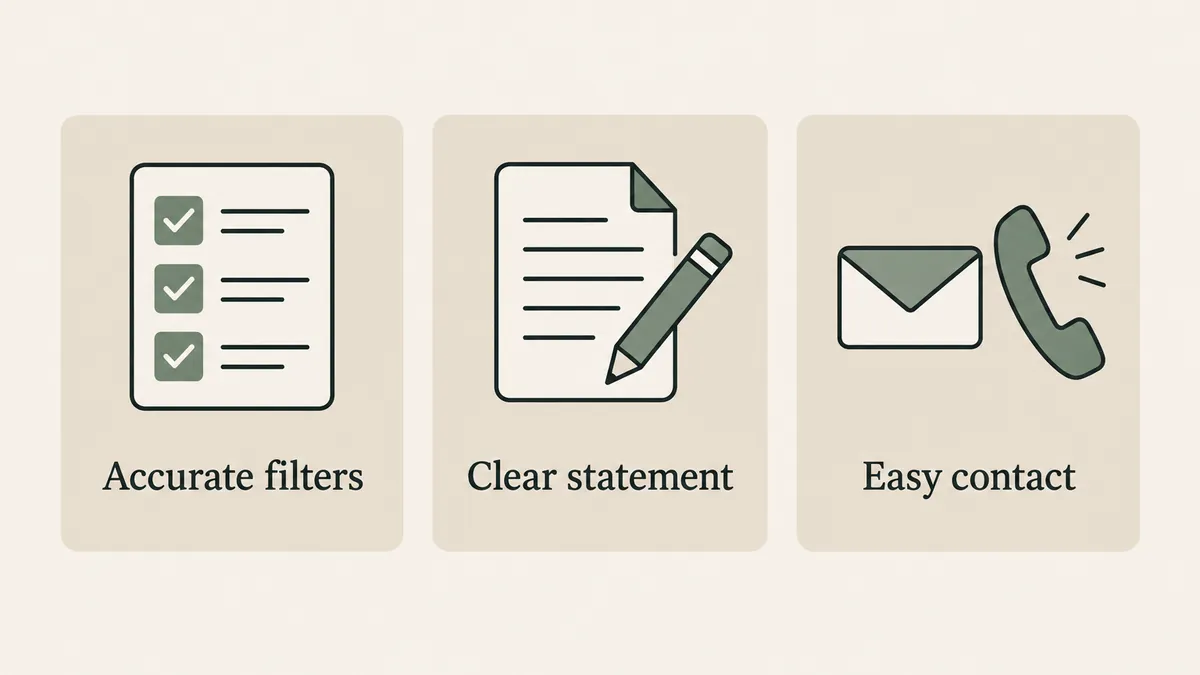
- Whether you appear in a filtered search at all. The filters a client uses (issue, insurance, type of therapy, age, price, language, online or in person) run on your checkbox sections, not on the words in your statement. Accurate, complete checkboxes put you in more of the right searches.
- Whether you get the click: photo, first line, starred specialties.
- Whether the view becomes a contact: statement, fees, and the note fields.
- Whether your profile page ranks on Google. Psychology Today profile pages can rank for phrases like “EMDR therapist Austin” on their own. That’s Google ranking your PT page, and it depends on the page saying your specialty and your city in plain words. One mention in the first line, one in each statement box and one in the specialties note is enough. Repeating a phrase sixteen times reads badly to the person you’re trying to reach and adds nothing for Google.
Field by field
Photo
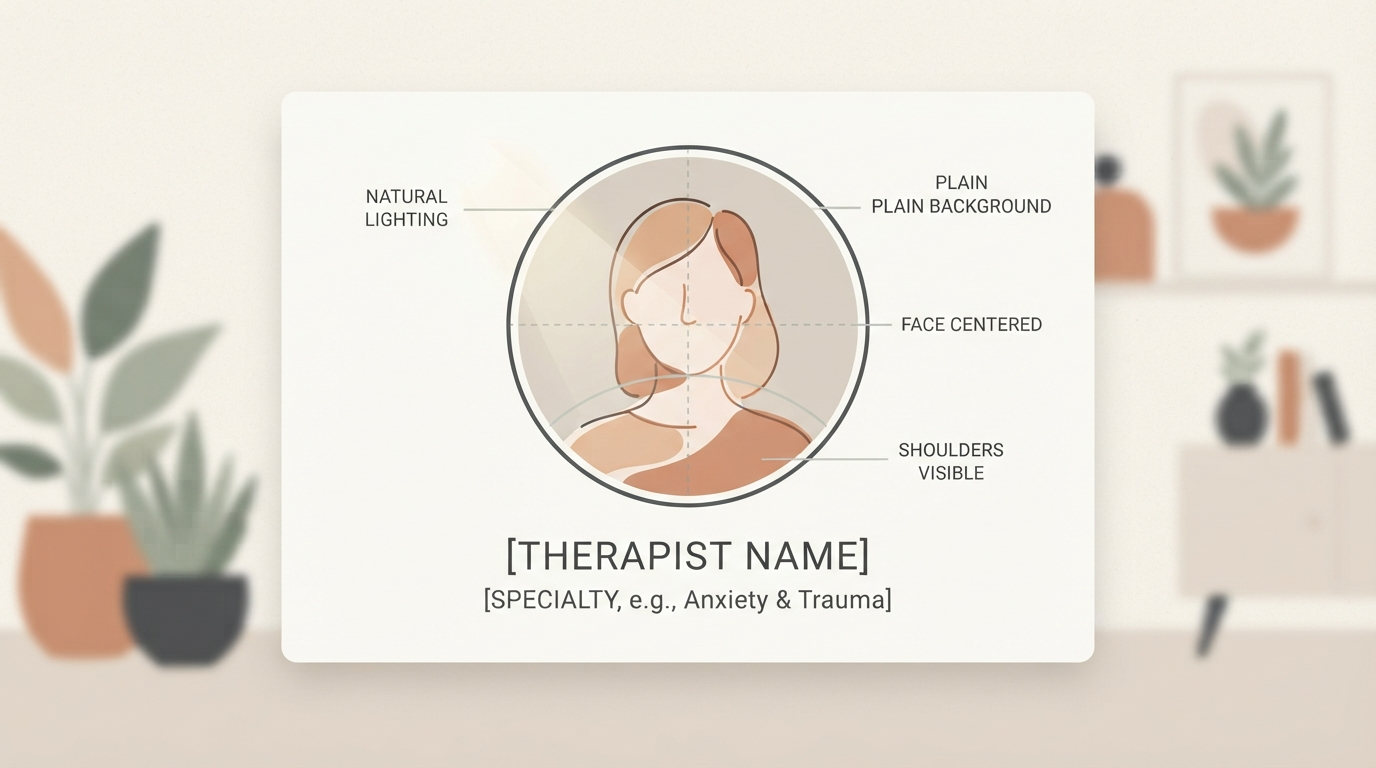
The minimum is 400×400 pixels, and the directory crops it to a circle in results, so anything near the corners disappears. Centre your face, keep your shoulders in frame, use a plain background and natural light, look at the lens, and smile slightly. A phone photo taken by a friend in good daylight is fine. Use the same photo on your website and Google Business Profile so a client who sees you in three places recognises one person. No logos, no group shots, no photo older than your current haircut.
The first line of your statement
Psychology Today no longer has a separate tagline field. The opening line of your first statement box appears under your name in search results and does the tagline’s job. Write it about the reader’s situation, not your credentials, which are on the card already.
A format that works: who you help, what they’re dealing with in their words, where.
- “Therapy for adults in Denver whose anxiety looks like overworking, not panic.”
- “EMDR for trauma, in person in Austin or online across Texas.”
- “Couples in Manchester who argue about the same three things every week.”
What to avoid: “Licensed Clinical Social Worker with 12 years of experience providing a safe space.” The first half is on the card already; the second half is on every other card too.
The personal statement: three boxes, 1,360 characters
The statement is three boxes: roughly 640 characters, then 360, then 360, for 1,360 in total. That’s about 220 words. Nothing else on the profile is long-form, so this is where the contact is won.
- Box 1: the client’s problem in their language, who you work with, and what changes. Second person. Expand the first line rather than restarting.
- Box 2: how you work. Name your main modality once, then describe what a session is actually like.
- Box 3: one human detail, then the next step: “Email me through this page or book a free 15-minute call on my website.”
Write it long first, then cut to the counter. Read it aloud. Anything you wouldn’t say to a client in the room comes out.
Top specialties and the specialties list
You can star three Top Specialties, and they show prominently on the card and the profile. Star the three you want more of, not the three you happen to do most.
For the full checkbox list, 10 to 15 is a workable range. This is a heuristic therapists have converged on, not a Psychology Today rule: below about ten you drop out of filtered searches you could serve; above fifteen the profile reads as unfocused to the person who lands on it. One check before you commit: search the directory as a client in your city with each filter applied and note how many profiles come back. A specialty with real demand and forty competitors is a better star than one with four hundred.
Types of therapy and client focus
Tick the modalities you actually use and would name in a session. Under client focus, set age ranges, communities and languages accurately. Each of these is a filter. Aspirational ticks produce contacts you’ll have to turn away, which costs you the reply time and costs them another week of looking.
Finances
Clients filter by insurance and fee before they read a word of your statement, so state your fee. A blank fee doesn’t hide the price; it removes you from price-filtered searches and moves the awkward question into the first email. List every plan you’re paneled with. If you’re out of network, say so in the Note on Finance and explain superbills in one sentence.
Location and zip codes
For in-person work, enter the office address and use the zip codes the editor allows per location (three, as of 2026) for the areas clients actually travel from, not three that overlap one neighbourhood. For online work, list every state you’re licensed in, and say it in the statement too (“online across Colorado”): the checkbox handles the filter, the sentence handles the human.
The five note fields most profiles leave blank
Beside the checkbox sections sit five short free-text fields, each capped somewhere between about 140 and 400 characters:
- Intro to new clients: what the first session is like, in one or two sentences.
- Note on Finance: superbills, sliding-scale slots, cancellation policy.
- Note on Credentials: licence number and state, relevant training (EMDRIA, Gottman and so on).
- Note on Top Specialties: the plain-language version of your three stars, with your city. It’s indexable text, so it’s the natural place for “[specialty] therapist [city]” to appear once.
- Note on Therapy Types: one sentence on what your main modality looks like in the room.
Most profiles in any city leave all five empty, which makes them the easiest advantage on the page.
Video and endorsements
Psychology Today accepts a short MP4 intro video; the editor states the current length limit. Twenty seconds on a phone in daylight, saying who you help and what a first session is like, does more than a polished credential recital. Endorsements come from colleagues who know your work and should be labelled as such. ACA and APA ethics codes restrict soliciting testimonials from current clients, and a reader who mistakes an endorsement for a client review trusts you less, not more.
Contact settings and response time
Turn on email and the protected phone number, and add your website link. Then treat response time as part of the profile. Someone who emails three therapists usually goes with the first good reply. Aim for the same working day and never beyond 24 hours.
A Psychology Today profile example: before and after
Illustrative only; not a real practice.
Before:
I am a Licensed Professional Counselor with over 10 years of experience helping individuals overcome anxiety, depression, trauma, relationship issues, grief and life transitions. I provide a safe, non-judgmental space where you can explore your feelings and work toward healing and growth. My approach is integrative and client-centered, drawing on CBT, ACT, mindfulness and psychodynamic techniques to meet each client where they are.
After, Box 1:
You’re good at your job, your friends think you’re fine, and you haven’t slept properly in months. Anxiety in high-achieving adults rarely looks like panic. It looks like overworking, rereading every message you send, and a jaw you can’t unclench. I work with adults in Denver, in person and online across Colorado, who want the noise to stop without giving up their ambition. Sessions are practical: we find what the anxiety is protecting you from and build ways to meet that need that don’t cost you your evenings.
Box 2:
I’m trained in CBT and ACT and use both, alongside plain conversation. A first session is mostly questions from me and one small experiment for you to try before we meet again. No homework packets. Every four sessions we check what’s changing and adjust.
Box 3:
Outside the office I run slowly, cook badly and start more books than I finish. If this sounds like the right fit, email me through this page or book a free 15-minute call on my website. I reply within one working day.
What changed: it opens on the reader’s week instead of the writer’s CV; city, modality and format each appear once; the promise is specific; the next step is one sentence. The “before” could belong to any of a thousand profiles. The “after” fits the same three boxes and could only be one therapist.
Track it: the two numbers that matter
Your account shows profile views and contacts. Once a month, log views, contacts (calls plus emails), and contacts per 100 views. There’s no published benchmark, so your first month is the baseline. If views are low, the problem is upstream: photo, first line, checkboxes, zip codes. If views are healthy and contacts aren’t, the problem is on the page: statement, fee, note fields. Change one thing, wait thirty days, log again.
Common mistakes
- Opening the statement with a licence and a year count.
- Ticking every specialty you’ve ever treated.
- Leaving the fee blank.
- Three zip codes that cover one neighbourhood.
- Five empty note fields.
- A website link that lands on a homepage with a different photo, different specialties and no fee.
- A profile nobody has read in a year. Review it quarterly and whenever your availability changes.
Where the profile stops and your website starts
Psychology Today’s own FAQ for new members says many find they “no longer need a website” after joining. For some practices that holds for a while. The mechanics say otherwise for most:
- 1,360 characters. A client comparing five profiles has questions the statement can’t hold: what the first session is like, how superbills work, what you’re like at length, how to book. Your website link is the only place those get answered, and it’s where the decision is made.
- The order rotates. Your place in the list this Tuesday isn’t yours. A website you own can rank on Google for the same “[specialty] therapist [city]” phrases and stays there. Our guide to local search for therapists covers how the site and Google Business Profile work together.
- The map. When someone searches “therapist near me”, Google shows local results drawn from Google Business Profile listings. A directory profile can’t appear there. A practice with a verified profile and a website can.
- Identical circles. In any city search you are one of hundreds of near-identical cards. Your site is the only page on the internet that is entirely about your practice, in your words, at your length, with your booking flow.
- Ownership. Fees, features and rules on the platform can change, and the listing exists for exactly as long as the subscription does. Your domain, your content and your contact list stay yours.
The sequence that works for most practices isn’t either/or. Keep Psychology Today. Build the profile as above so it converts. Then give the click somewhere to land that continues the same conversation: same photo, the first line as the hero, a fees page, contact or booking one tap away, fast on a phone, forms that don’t store client health information. That is what a therapist website is for, and it’s why the website-versus-directory question has a boring answer: both, in that order.
If you already have a website, we’ll look at what a Psychology Today click sees: how fast it loads on a phone, how many taps to contact you, and whether you appear for “[your specialty] therapist [your city]”. Five fixes in plain English, no pitch attached.
Frequently asked questions
How much does a Psychology Today profile cost?
$29.95 a month for the US directory, with no contract, as listed on Psychology Today’s membership page in September 2026. Other countries’ directories are priced separately.
How many specialties should I select on Psychology Today?
Star three Top Specialties and tick roughly 10 to 15 in the full list. It’s a heuristic, not a platform rule; the aim is to appear in the filtered searches you can serve without reading as unfocused.
Should I put my fee on my profile?
Yes. Clients filter by fee and insurance before reading statements, so a blank fee removes you from those searches without making you look more affordable.
Can I use client testimonials on my Psychology Today profile?
No. Endorsements come from colleagues and should be labelled as such. ACA and APA ethics codes restrict soliciting testimonials from current clients.
Is Psychology Today worth it for therapists?
At $29.95 a month, a profile built the way this guide describes pays for itself with a fraction of one client. The better question is how much of your caseload should depend on it, which we work through in Is Psychology Today worth it? A real ROI breakdown.
How often should I update my profile?
Quarterly, plus immediately when your fee, availability, insurance panels or licensed states change. Stale availability is the fastest way to lose a contact you already earned.