
A prospective client reads your bio, likes you, and clicks Fees. The page says “Contact me for rates.” Or it shows one number with nothing around it. It’s 10 p.m., and there’s nobody to ask.
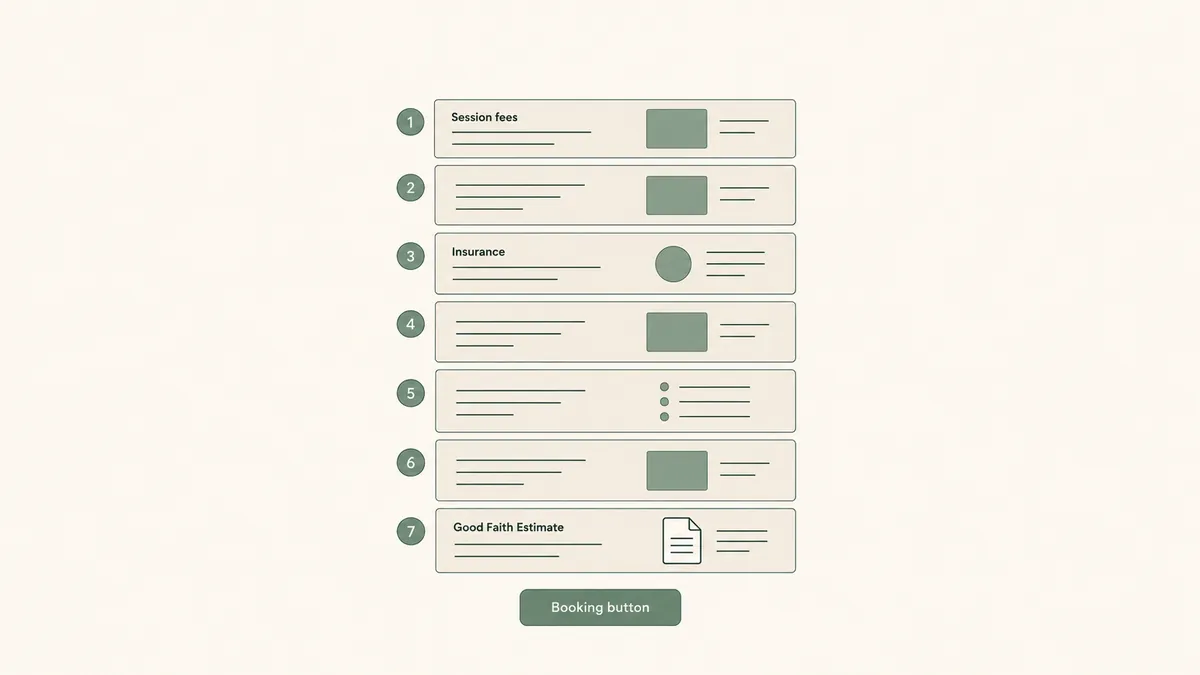
Your therapy fees and insurance page has seven small jobs: state your fee, describe any reduced-fee spots, list the plans you take, explain out-of-network benefits, set cancellation terms, say how to pay, and carry the Good Faith Estimate notice. Sample wording for each is below.
Should therapists list their fees on their website?
Yes, in our opinion. After building 500+ websites for therapists and coaches, we recommend publishing your session fee on its own page, with your insurance options beside it. A clear number lets a prospective client decide in private whether to reach out. It also screens out some people who can’t afford you.
That’s a professional opinion, and we won’t dress it up with a conversion statistic. In client audits, two versions keep turning up. “Rates available on request” asks a stranger to open a money conversation before they’ve met you. A bare “$[XXX] per session” answers one question and raises several more.
Skip “rates available on request.” Publish the number, then answer the questions around it. Here’s the full page, in the order we’d build it.
| Section | What it answers | Sample first line |
|---|---|---|
| Session fees | Cost and length of a session | “Individual sessions are [$XXX] for [50] minutes.” |
| Reduced-fee spots | Whether a lower fee is open | “I hold [number] reduced-fee spots.” |
| In-network insurance | Which plans you take | “I’m in-network with these plans in [your state]:” |
| Out-of-network and superbills | How to use other plans | “I’m an out-of-network provider.” |
| Cancellation policy | Cost of a late cancellation | “Please give at least [24 / 48] hours’ notice.” |
| Payment methods | How and when to pay | “Payment is due at each session.” |
| Good Faith Estimate notice | The right to a cost estimate | “You have the right to receive a Good Faith Estimate.” |
One limit on our side: we design websites, and we don’t draft policies. Treat each sample as a starting draft; your contracts and state rules have the final say.
Lead with the number: session fees and reduced-fee spots
Session fees
Plenty of fee pages open with paragraphs about the value of therapy and reach the fee near the bottom. Flip it. Put the fee first with three details attached: which session it covers (intake or ongoing), how long it runs, and who it’s for. If your intake costs more than a regular session, say so here.
Sample wording (adapt it):
Initial intake session ([60] minutes): [$XXX]
Individual therapy ([50] minutes): [$XXX]
Couples or family therapy ([60] minutes): [$XXX]
Sliding scale therapy and reduced-fee spots
The honest version of a sliding scale names its limit. “Sliding scale available” reads like an open door. If your three reduced-fee spots have been full since spring, the person who works up the nerve to ask gets a no.
So state how many spots you hold, whether one is open now, and what happens when they’re full.
Sample wording (adapt it):
I hold [number] reduced-fee spots for clients who can’t manage my full fee. They’re currently [full / open]. Reduced fees range from [$XX] to [$XXX] per session. When the spots are full, I can [add you to a waitlist / suggest lower-fee options in [your state]].
Insurance, out-of-network benefits, and the superbill for therapy
In-network plans
List each plan the way it appears on a member’s card, typed as text. A row of insurer logos with no alt text is invisible to a screen reader and to anyone pressing Ctrl+F.
Then ask clients to verify their own benefits. Being in-network with an insurer doesn’t always mean every plan that insurer sells.
Sample wording (adapt it):
I’m in-network with these plans in [your state]: [Plan name], [Plan name], [Plan name]. Coverage varies by plan. Before our first session, please call the number on your insurance card to confirm your mental health benefits and what you’ll owe per session.
Out-of-network benefits and superbills
For an out-of-network or private-pay practice, this section does the most work. Picture the reader: insured through work, never used the plan for therapy, never heard the word “superbill.” Two plain sentences fix that. After those, hand them a script. “Call your insurance” with no questions attached is a chore people put off.
Sample wording (adapt it):
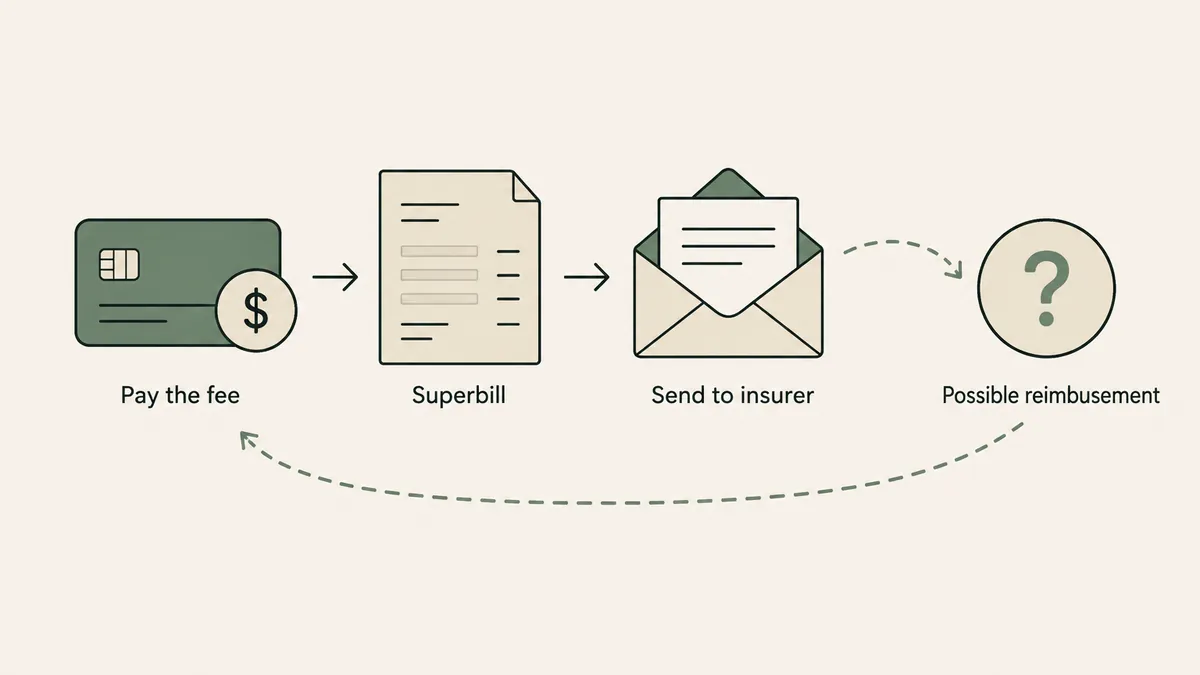
I’m an out-of-network provider. If your plan includes out-of-network benefits, you pay my fee at each session and I give you a superbill [each month]. A superbill is an itemized receipt for your sessions with the details insurers ask for. You send it to your insurance company, and they may reimburse part of the fee, depending on your plan.
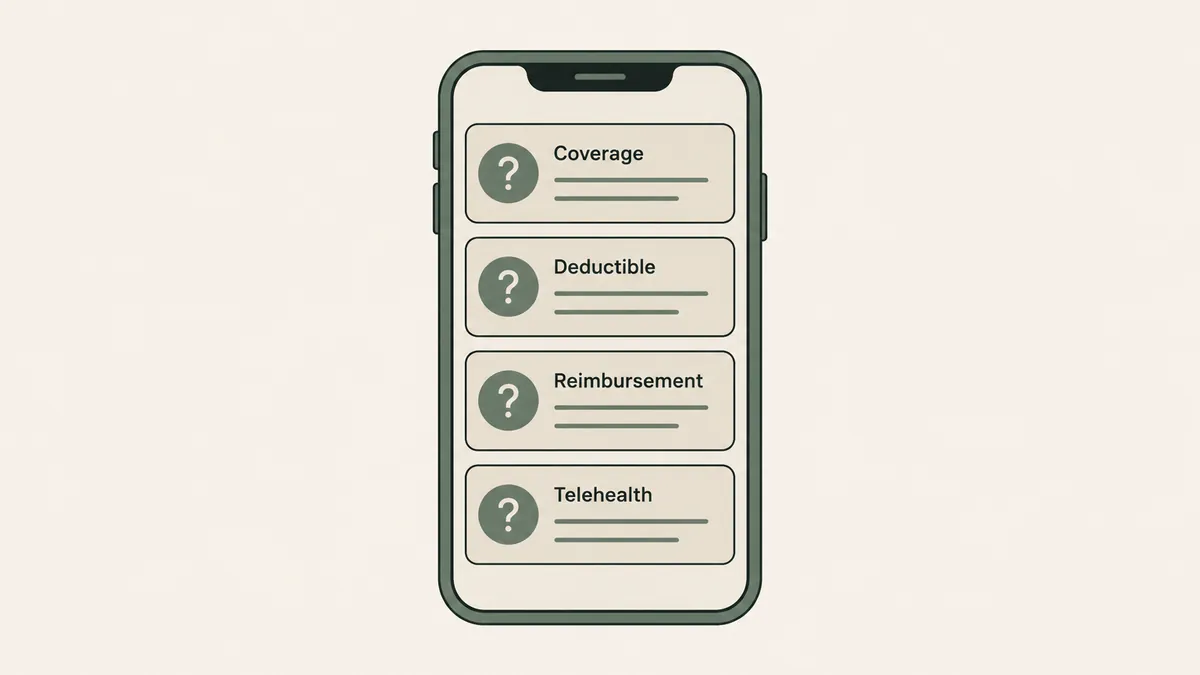
Before we start, call the number on your insurance card and ask:
- Do I have out-of-network coverage for mental health services?
- What is my out-of-network deductible, and how much of it have I met?
- After the deductible, what percentage or amount do you reimburse per session?
- Is telehealth covered out of network?
Notice what’s missing: any figure for what the client gets back. You don’t know their plan. Neither do we.
Cancellations and payment, in plain words
Cancellation and late-cancel policy
Write this as a rule with numbers in it: the notice window, the fee, and how to reach you. Warm is fine. Vague isn’t. “Please be respectful of my time” tells a parent nothing about what happens when their kid spikes a fever at 7 a.m. on session day.
If you’re in-network with any plan, check your contract’s terms on missed-session fees before you publish.
Sample wording (adapt it):
If you need to cancel or reschedule, please tell me at least [24 / 48] hours ahead by [phone / portal message]. Sessions canceled with less notice, and missed sessions, are charged [the full session fee / $XX].
Payment methods, HSA and FSA cards
Say when payment is due, which methods you take, and whether a card stays on file. Name HSA and FSA cards if you accept them. What an account covers is between the client and their plan administrator, so leave that promise off the page.
Sample wording (adapt it):
Payment is due at each session. I accept [major credit and debit cards] and HSA or FSA cards, with a card kept on file through [my client portal]. Please check with your HSA or FSA administrator about what your account covers.
The Good Faith Estimate notice goes on this page too
This is the one section with a federal rule behind it, so we’ll stick to the regulation and CMS.
Under the No Surprises Act, health care providers must give a Good Faith Estimate of expected charges to uninsured or self-pay clients: people with no coverage for the service, and people with coverage who don’t seek to have a claim submitted to their plan. The regulation, 45 CFR 149.610, defines a provider as “a physician or other health care provider who is acting within the scope of practice of that provider’s license or certification under applicable State law.” Read plainly, that reaches licensed therapists in private practice.
The timeframes:
- Session scheduled at least 3 business days ahead: no later than 1 business day after scheduling.
- Scheduled at least 10 business days ahead: no later than 3 business days after scheduling.
- If a client asks for an estimate, you have until 3 business days after the request.
One written estimate can cover recurring sessions, as long as its scope doesn’t exceed 12 months.
Now the website part. Information about the availability of Good Faith Estimates must be “prominently displayed (and easily searchable from a public search engine) on the convening provider’s or convening facility’s website, in the office, and on-site where scheduling or questions about the cost of items or services occur.” It also has to be given orally when people schedule or ask about cost. Our reading as web designers, not lawyers: “easily searchable” points to live text on a public page, and a PDF behind a portal login won’t get there.
Where to find the model notice and a good faith estimate template
Don’t write your own notice. CMS publishes a model notice, and its instructions say “HHS considers use of the model notice to be good faith compliance” with the duty to inform people of this right. Using it is optional. It carries the dispute line your clients should see: “If you receive a bill that is at least $400 more for any provider or facility than your Good Faith Estimate from that provider or facility, you can dispute the bill.”
If you need a good faith estimate template for the estimate itself, start with the free model form on the CMS rules and fact sheets page before paying for one.
Sample wording (adapt it):
Good Faith Estimate. If you don’t have insurance, or choose not to use it, you have the right to receive a Good Faith Estimate of what your sessions are expected to cost. [Paste the CMS model notice text here.] To request one, [email / call] [contact details].
This section is general information, not legal advice; confirm how the rule applies to your practice with your own attorney or compliance resource.
Give your therapy fees and insurance page its own spot in the main navigation
A fees page tucked under About, or folded into an FAQ accordion, works about as well as no fees page. Make it a standalone page and label it “Fees & Insurance” in the main navigation. Skip “Investment.” A menu label should name the thing. Then link to the page from every service page, right next to the booking button, because that’s where the money question shows up.
If your site is being rebuilt anyway, through Website in a Week or a longer custom build, ask for this page from day one. Our roundup of therapist website examples is a good place to study how full practice sites arrange their pages.
End the page with a next step. A reader who has made it through your policies and a federal notice is about as ready as readers get.
Sample wording (adapt it):
Questions about fees or insurance? [Send me a message] and I’ll reply within [2 business days]. Ready to start? [Book a free 15-minute consultation].
What to leave off the page
- Insurance jargon with no explanation. “OON,” “CPT code,” “allowed amount.” Explain a term in the sentence where you use it, or drop it.
- Apology language. “Unfortunately, my fee is…” invites the reader to doubt the number before they’ve considered it. State your fee the way you’d state your office hours. Warmth belongs in your bio, and our therapist bio examples cover that page.
- Reimbursement promises. Never publish a line like “most clients get [XX]% back.” You can’t know a stranger’s plan, and they’ll hold you to the figure.
Publishing your fee will screen some people out
Here’s the trade-off, stated plainly. When your fee is public, some people will see it, decide it’s beyond their budget, and leave without contacting you. You won’t know how many. We can’t put a number on it either.
That’s the right outcome for both sides, in our view. The person who can’t afford your fee learns it in ten seconds, in private, and can keep looking the same evening. The alternative is finding out at the end of a consult call. And your consultation slots go to people who can start.
There’s a real cost. A few of the people who leave might have fit a reduced-fee spot, or had out-of-network benefits they didn’t know about. That’s the argument for the other six sections.
Questions therapists ask about fee pages
What is a superbill for therapy?
A superbill is an itemized receipt a therapist gives a client who pays out of pocket. The client sends it to their insurer to request out-of-network reimbursement. What comes back depends on the client’s plan, so explain the document without predicting the result.
Do I need a Good Faith Estimate notice on my website?
The federal regulation says information about Good Faith Estimate availability must be prominently displayed on the provider’s website, in the office, and where scheduling or cost questions happen. CMS publishes a model notice you can use. Ask your attorney how the rule applies to your practice.
I only take insurance. Do I still need to list a fee?
Yes. Some prospective clients will have a plan you don’t take, and some will choose not to use their insurance. Publish your self-pay fee for them, and list your in-network plans beside it.
A therapy fees and insurance page is one of the smallest pages on a practice site, and we’d still write it before the blog or the newsletter signup. Start with the number. If you’d like a site planned around pages like this one, get a custom quote through the Website Inquiry Form. The consultation is free, and nobody will rush you.