It’s 11 PM. Someone in your city just typed “I need a therapist for postpartum anxiety who takes Aetna” — not into Google, into ChatGPT. Four seconds later it named three practices, with a sentence about each. Were you one of them?
That’s what this guide is for: AI search for therapists, minus the panic and minus the invoice for services you don’t need. Just the specific, checkable things that make AI engines cite a practice by name.
In this guide: How AI search results get chosen · What GEO is · Three pillars · ChatGPT vs. AI Overviews vs. Perplexity · The 2026 checklist · What it won’t do · Where SEO fits · FAQ
How do you get a therapy practice into AI search results?
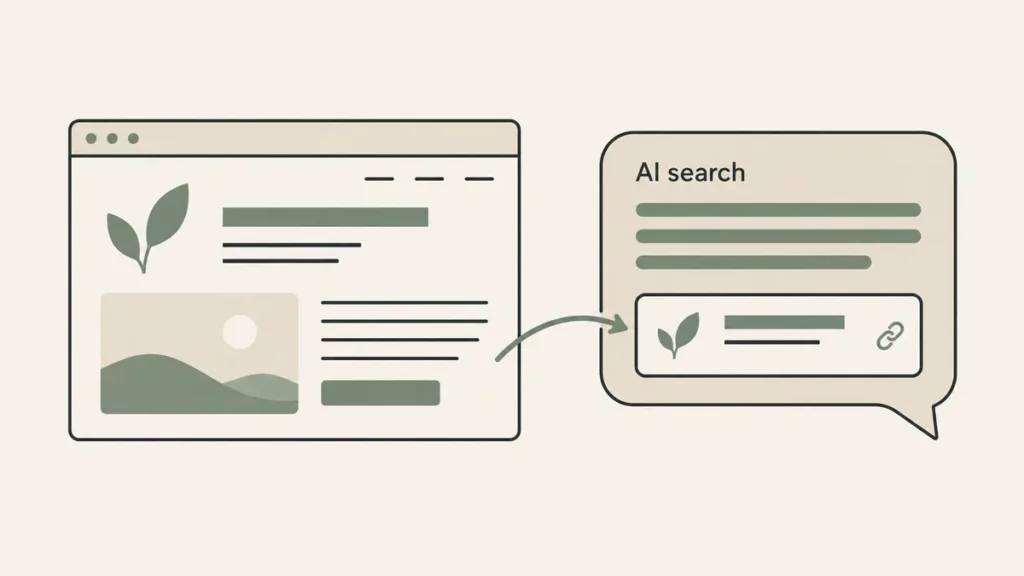
To show up in AI search, make your practice website easy for machines to read and easy to trust: plain-language service pages, FAQ and Person schema, consistent name-address-phone details across the web, and credentials an AI can verify — your license, your specialties, and mentions on sites beyond your own.
That’s the strategy in one paragraph. Everything below is the how: what each piece looks like on a real practice site, which engines reward which signals, and a checklist you can run this month.
One reframe before we start. AI search didn’t change what makes a practice findable. It changed where the answer shows up.
What is generative engine optimization (and why isn’t SEO enough)?
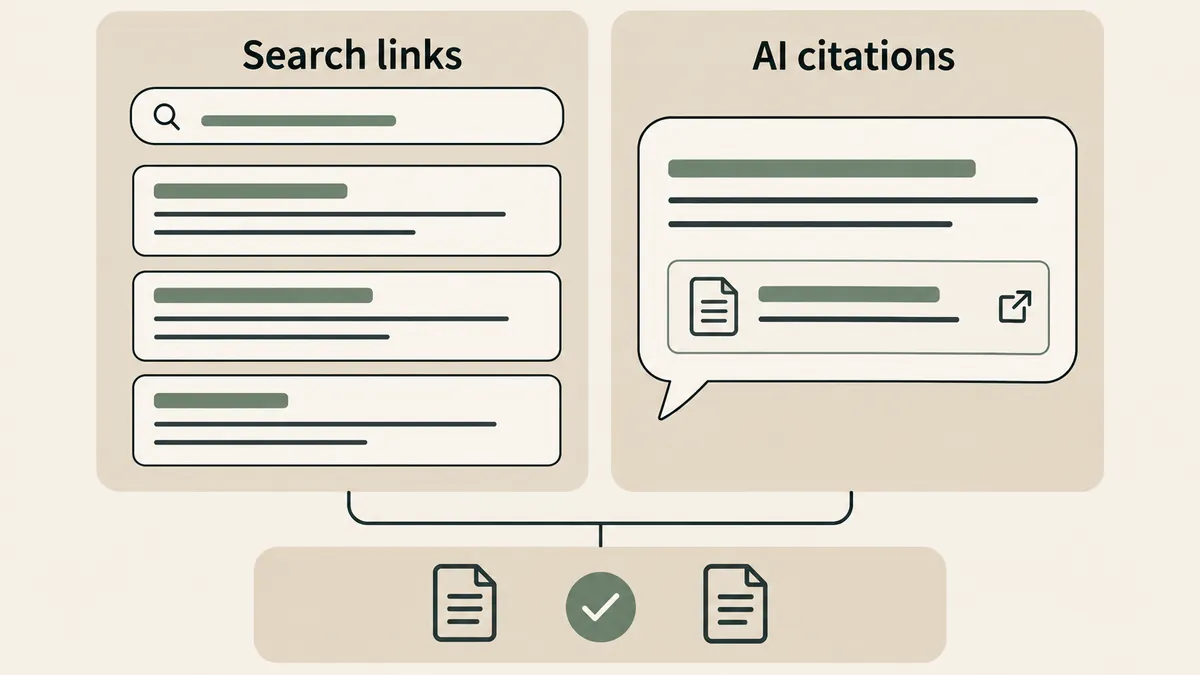
Generative engine optimization (GEO) is the work of getting your practice named inside AI-written answers. Classic SEO earns you a spot in a list of links. GEO earns you a citation in the paragraph above that list — or in a ChatGPT reply that never shows a list at all. You’ll also hear it called answer engine optimization, LLM SEO, or AI SEO. Same homework, different sticker.
Here’s the part most GEO sales pitches skip: the majority of the work is the same work. Clear pages. Real expertise, stated plainly. Structured data. Listings that agree with each other. Good SEO already demanded all of it. What’s changed is the finish line, and how the win gets counted.
| Classic search (SEO) | AI search (GEO) | |
|---|---|---|
| Where you appear | A ranked list of links | Inside the written answer |
| What gets rewarded | Page relevance and authority | Clear, verifiable, quotable passages |
| The click | The whole point | Optional; the mention itself builds trust |
| How you measure it | Rankings and traffic | Citations, mentions, branded searches |
The uncomfortable half of that table: when an answer satisfies the searcher, some clicks never happen. We’ll get to what that costs you, and what it doesn’t, a little further down.
Three pillars of AI search for therapists
Every engine weighs signals differently, but the practices getting cited share three traits. Miss one and the other two carry less.
1. Machine-readable content
AI systems quote what they can parse. Two fixes matter most.
First, language. Your training gave you precise clinical vocabulary; your clients don’t search with it. A page titled “Somatic and Polyvagal-Informed Modalities” describes you accurately and matches almost nothing anyone types at 11 PM. “Trauma therapy for when talking about it hasn’t helped” matches plenty. Keep the credentials on the page — just lead with the client’s words. In the client audits we run, this is the pattern we see week after week: beautiful sites that describe the therapist’s training and never once use the words a client would type.
Second, structure. One H1 per page. Headings that state answers, not themes. One service per page instead of a single “Services” wall. And JSON-LD schema, so machines don’t have to guess: Person markup for you (name, credentials, license state), LocalBusiness or MedicalBusiness markup for the practice, FAQPage markup for questions you actually answer on the page. This is standard scope in professional private practice website design; if your current site can’t support it, that’s a build conversation, not a blog-post fix.
2. Entity authority
AI engines don’t just read your site. They cross-check you. Does this practice exist? Does the clinician hold the license the site claims? Do other credible places mention the same name, credentials, and address?
Google’s quality raters call this E-E-A-T: experience, expertise, authoritativeness, trust. AI engines run the same background check at machine speed. That’s why consistency is worth an unglamorous afternoon: identical name, address, and phone details on your site footer, Google Business Profile, state licensing board record, LinkedIn, and any directory profiles. It’s the same discipline behind local SEO for therapists, and it feeds AI answers directly — Google’s AI Overviews lean on local signals for “near me” questions.
And yes, your Psychology Today profile counts here. A directory listing is a decent entity signal. It’s a poor home base. When an AI cites the directory instead of you, the click lands on a page where you sit beside dozens of other therapists under the platform’s logo, not yours. Keep the profile if it pays for itself; build the authority into the site you own. It’s the case we’ve made for years about websites versus therapy directories, and AI search just raised the stakes.
3. Conversational intent
People don’t talk to ChatGPT in keywords. Nobody types “therapist anxiety Columbus” into a chat box. They type the couch version: “I think I need therapy but I can’t afford $200 a session, what are my options in Columbus?”
Pages that get cited answer questions in the shape they’re asked. Practically, that means an FAQ section built from your actual intake calls, answered in two to four honest sentences: what sessions cost without insurance, whether you offer telehealth and in which states, how a first session goes, the difference between a counselor and a psychologist. If every answer on your site requires a phone call to get, an AI has nothing to quote — and neither does a nervous first-time visitor.
ChatGPT, Google AI Overviews, and Perplexity: what each rewards
Think of these as three doors into the same room. The foundations above open all of them; the finishing touches differ.
| Engine | Pulls from | What earns the mention | First move |
|---|---|---|---|
| Google AI Overviews | Google’s regular search index plus local data | Pages that already rank for the query family; strong local entity signals | Keep ranking — there is no separate AI index |
| ChatGPT (search) | Live web browsing plus trained knowledge | Authority mentions of you across the web; crawlable, quotable pages | Allow OAI-SearchBot in robots.txt |
| Perplexity | Live retrieval, citation-first | Clearly structured passages it can footnote | Allow PerplexityBot; one clean answer per section |
One detail that trips people up: blocking “Google-Extended” in robots.txt controls whether Google trains its Gemini models on your content. It does not remove you from AI Overviews, which are generated from the same index regular Googlebot builds. If visibility is the goal, the crawlers to check are OAI-SearchBot, PerplexityBot, and plain old Googlebot. OpenAI publishes its crawler list, and Google’s guidance on AI features and your website is worth ten minutes from whoever manages your site.
Perplexity deserves special mention as the citation stickler of the three. Every claim in its answers carries a numbered footnote, which makes it the easiest engine to audit: search your own specialty and city tonight and see who’s earning the little [1].
The 2026 AI-readiness checklist
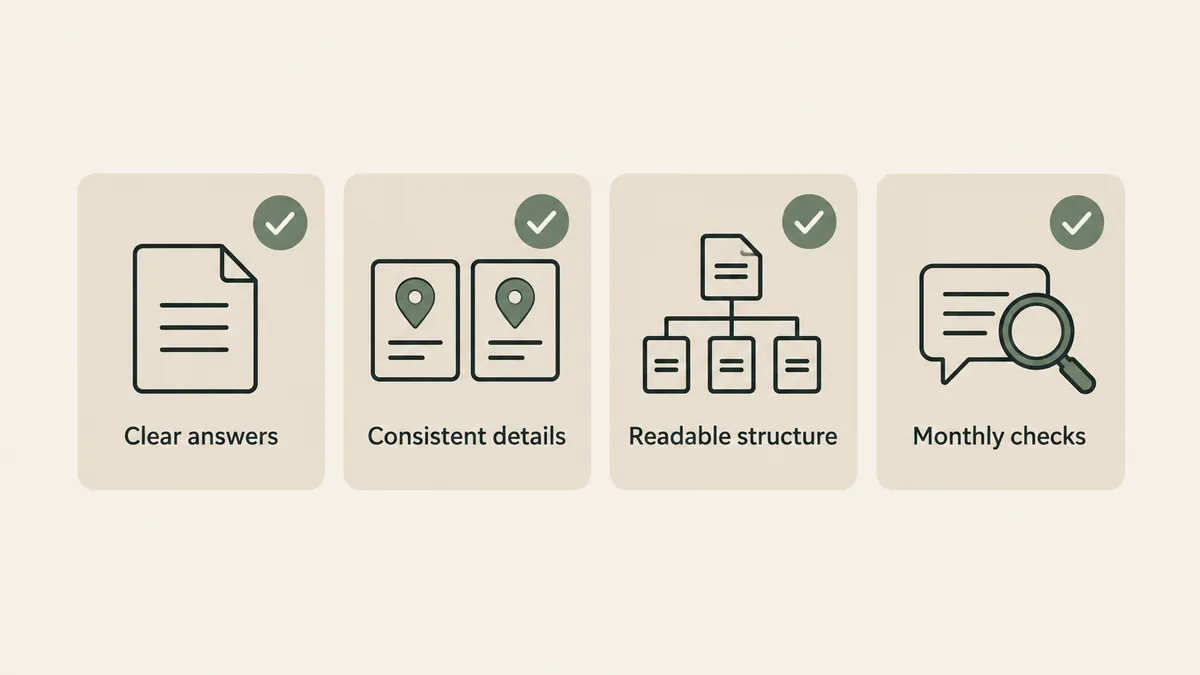
Run this in an afternoon. Most items are fixes, not projects.
- Rewrite your top three service pages in the language clients use, keeping credentials but leading with their words.
- Add three to five real intake-call questions to each key page, answered in plain sentences.
- Publish a full About page: your name, credentials, license state, specialties, and a professional photo.
- Match your name, address, and phone exactly across your site, Google Business Profile, licensing-board listing, LinkedIn, and directories.
- Check robots.txt to confirm OAI-SearchBot, PerplexityBot, and Googlebot aren’t blocked (many “block AI” plugins block everything at once).
- Install Person, LocalBusiness, and FAQPage schema, or have your designer handle it.
- Test monthly: ask ChatGPT, Perplexity, and Google the questions your clients ask, and note who gets named.
If the checklist keeps hitting the same wall (a theme you can’t edit, structure the builder fights, pages you’d hesitate to send a client to), that’s not an optimization problem. It’s a build problem. Website in a Week exists for exactly that gap: a custom site, structured for this from day one, live in 7 days.
What AI search won’t do for your practice
Time for the honest section.
AI answers keep some clicks for themselves. When an overview fully satisfies a question, the visit you used to get never happens. For thin informational traffic, that loss is real and mostly permanent. The consolation matters, though: the people who do click through arrive having already read a summary that named you. Fewer visitors, warmer ones.
Second: nobody can guarantee you a citation. Not us, not anyone. These systems change their sources and behavior month to month, and there’s no submission form and no paid shortcut into an organic answer. Anyone promising “we’ll get you into ChatGPT” is selling confidence, not a deliverable. What can be promised is the boring part — a site structured so that when engines go looking for a practice like yours, yours is easy to choose.
Third, an opinion: skip the AI-visibility tracking dashboards for now. The tools are immature and the subscriptions add up fast. A monthly manual check (item 7 above) tells a solo practice everything it needs to know, for free. Revisit the dashboards when your site is earning citations worth counting.
Where this fits with the SEO you’re already doing
If you’ve invested in search at all, nothing here asks you to start over. AI Overviews are built from the same index your rankings live in, so the reliable path into them runs through the SEO you already know: pages that rank, links that vouch, listings that agree with each other.
In our own SEO and digital marketing work for practices, we don’t treat GEO as a separate line item. It’s the same monthly foundation with two additions layered on top: deeper schema, and content shaped like answers.
We’ve built 500+ websites for therapists and coaches, and the pattern among the ones that get found hasn’t changed with AI: the practices that win are specific, consistent, and easy to verify. The engines are new. The homework isn’t.
FAQ: AI search questions therapists are asking
Will AI search replace my website?
No — it raises the bar for having one. An AI answer needs sources to draw from and cite. If your practice’s only web presence is a directory profile, the AI cites the directory. Your website is what lets the answer point at you.
Do I have to pay to show up in ChatGPT or Google’s AI answers?
You can’t buy an organic citation. Ads appear around some AI results, but the citations inside answers are earned through the signals in this guide. Treat any “guaranteed AI placement” offer the way you’d treat a guaranteed-caseload offer: politely, and from a distance.
Is any of this a privacy or HIPAA problem?
Optimizing public marketing pages doesn’t involve protected health information; AI crawlers read the same public site any visitor can. Where care is required: never paste client details into AI chat tools, and keep intake forms and booking on systems covered by a BAA. Public visibility and private data are separate lanes. Keep them that way.
Should I block AI crawlers instead?
You can, and some site owners do it to keep content out of training data. Just know the trade: blocking GPTBot limits training use, while blocking OAI-SearchBot or PerplexityBot removes you from the answers your future clients are reading. For a practice that wants to be found, visibility usually wins.
How long does AI search optimization take to work?
The fixes take an afternoon to a few weeks. The citations follow no fixed schedule: engines re-crawl and re-weigh sources constantly, and specific local questions (“EMDR therapist in Boise who sees teens”) move much faster than broad ones. Expect movement in months, not days — and distrust anyone more precise than that.
Does my Psychology Today profile help or hurt AI visibility?
As one consistent listing among several, it helps. As your primary web presence, it hurts, because every AI mention it earns promotes the platform’s page instead of yours. Keep it as a signal; don’t let it stand in for a home base you own.
Where to go from here
AI search for therapists isn’t a future problem; the 11 PM questions are already being asked and answered. Run the checklist this month. If it turns up a site that can’t carry the structure (or you’d rather spend those hours with clients), get a custom quote through the Website Inquiry Form. The consultation is free, and “make my practice show up in AI search” is a perfectly good opening line.