Zocdoc Solves One Problem Really Well — and That’s the Problem
Zocdoc built its reputation on one thing: frictionless online booking. Patients search, filter by insurance, and book appointments in under 60 seconds. For general medical practices, it’s a game-changer.
For therapists, it’s more complicated.
Zocdoc does get therapists appointments — there’s no question. The platform’s traffic is real, the booking flow is genuinely smooth, and the insurance filtering removes a common barrier for clients. But when you zoom out and look at what Zocdoc actually builds for your practice, the picture gets much thinner.
This post is a clear-eyed look at what Zocdoc does for therapists, where it hits hard limits, and why a professional website is what turns a practice from busy into sustainably growing.
What Zocdoc Does Well for Therapists
- No upfront fee — providers pay only when new patients book through the platform
- Insurance filtering — clients can search specifically for in-network therapists, removing a major decision barrier
- Built-in scheduling — Zocdoc’s calendar integration makes booking frictionless
- High-intent audience — people on Zocdoc are ready to book, not just browsing
- Trust signal — Zocdoc’s brand carries institutional credibility, especially with insurance-focused clients
The Hard Limits of Zocdoc for Private Practice Therapists
1. It’s transactional, not relational
Zocdoc is built for volume. Its UX is optimized for the fastest possible booking — not for helping a client understand who you are as a clinician. Therapy is fundamentally a relationship-based service. Clients need to feel emotionally safe before they’ll trust you with their most vulnerable experiences.
A 2-sentence Zocdoc bio and a star rating cannot carry the weight of that trust-building. Your website can — through depth of storytelling, video, approach descriptions, and content that educates and reassures.
2. You pay per booking — indefinitely, with no equity
Zocdoc’s model means every booking has a cost attached. Unlike a website, which generates leads for free once built and optimized, Zocdoc’s fees scale with your volume. And unlike a website’s SEO authority, which compounds month over month, Zocdoc generates zero long-term asset value. Stop listing, and you’re invisible.
3. Zocdoc attracts insurance-first clients — which may not be your ideal market
If you’re building a private-pay practice or trying to attract clients based on a specific therapeutic approach or niche, Zocdoc’s insurance-centric funnel is actually a mismatch. The clients filtering by ‘in-network’ are primarily price-sensitive, not approach-sensitive. Your ideal client — the one who specifically wants your modality, your background, or your specialization — is much more likely to find you through Google search than through Zocdoc.
4. You’re still one of many on a list
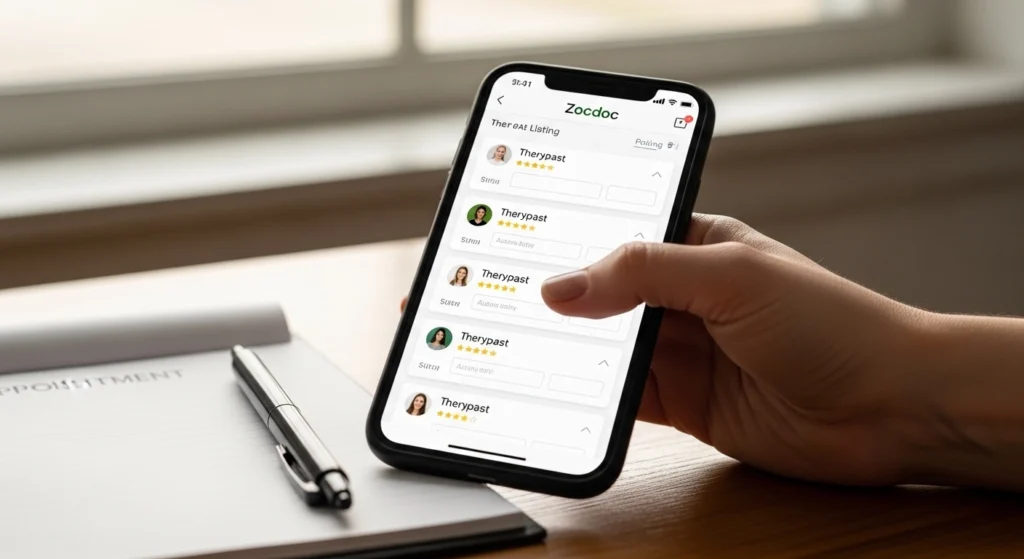
A client searching Zocdoc for a therapist in their city gets a long scrollable list sorted by availability and reviews. You’re competing on profile photo, star rating, and availability slot — not on your clinical expertise, your warmth, or why your approach to anxiety is different from the therapist two rows above you.
5. No SEO value passes to your practice
This is the same problem as every other directory: when someone clicks your Zocdoc profile from Google, Zocdoc gets the ranking credit. Your practice’s website gains nothing. After years of being on Zocdoc, your own domain’s authority is exactly the same as when you started. That’s not a growth strategy — it’s a treadmill.
Who Should Use Zocdoc — and Who Shouldn’t
Zocdoc makes real sense if you’re building an insurance-based practice, want to fill a new caseload quickly, or are in a saturated market where visibility is the primary bottleneck.
It becomes a liability as your primary channel if:
- You’re building a private-pay or sliding-scale practice on your own terms
- You want clients who find you based on specialty — not insurance network
- You’re concerned about per-booking costs as your practice scales
- You want a digital presence that builds value over time, not just fills slots
- You have a niche (trauma, EMDR, couples, teen therapy) that deserves more than a filtered list
What a Professional Website Does That Zocdoc Can’t
- Ranks your practice on Google for your specific specialties and city
- Tells your story — approach, training, therapeutic philosophy — in full
- Converts clients who are specifically seeking your niche, not just any available therapist
- Builds long-term SEO authority that compounds every month
- Captures leads who aren’t ready to book today but will be next month
- Supports content marketing, email capture, and referral relationships
- Costs nothing per booking once the SEO foundation is built
The Smarter Play: Website as Your Core, Zocdoc as a Channel
You don’t have to choose one or the other in the early stages. The strategic move is to build your website as your primary growth engine, and keep Zocdoc as a supplementary channel for insurance-based volume.
As your website’s SEO matures and your organic traffic grows, you’ll naturally reach a point where Zocdoc’s per-booking cost is no longer worth what you’re getting from it. At that point, you have leverage — something Zocdoc alone can never give you.
Ready to Own Your Online Presence?
Therapeia Web Design builds private practice websites that get therapists off the directory treadmill and onto Google’s first page for their specialties — permanently.
Book a Free Website & SEO Strategy Call → therapeiawebdesign.com/website-inquiry-form
Also read: Therapist Directories vs. Your Own Website: What Actually Grows Your Practice → therapeiawebdesign.com/website-vs-therapy-directories