
Most advice about therapist homepages is opinion. We wanted evidence, so we looked at the practice websites that actually appear on Google's first page when people search for a therapist or counsellor in their city, and measured what their homepages contain.
We reviewed the first page of Google for 28 searches across 13 US cities and 11 UK cities, from "therapist chicago" to "counsellor manchester", and audited every independent or group practice website we found: 96 practice websites (54 US, 42 UK). The method is at the end. Here is what page-one therapist homepages have in common, and how to use it for yours.
Key findings
- Your homepage competes with directories first. Psychology Today appeared in the organic top 10 for 27 of the 28 searches and was the #1 result for 12. Directories, marketplaces and therapy platforms took 35% of all first-page results. Practice websites took 40%, and held the #1 spot for only 3 of 28 searches.
- The title says the service and the city. 81% of ranking practices put both a location and "therapy", "therapist" or "counselling" in their homepage title. The median title is 58 characters.
- Booking habits differ by country. 57% of US practice homepages link to an online booking or client-portal tool, against 10% in the UK. SimplePractice accounts for 15 of the 35 sites with a booking tool.
- A phone number you can tap is standard. 72% have a click-to-call link (81% US, 60% UK). Only 23% put a contact form on the homepage itself, but 90% link to a contact page.
- Fees are signposted, rarely priced. 83% signal fees in some way, but only 18% state a price on the homepage (26% in the UK, 11% in the US).
- Insurance is a US homepage topic. 67% of US homepages mention insurance and 31% name a specific insurer. Only 17% of UK homepages mention insurance.
- A third offer a free consultation (41% US, 21% UK), and 73% mention online or video therapy.
- Ranking homepages are substantial. The median homepage has about 1,140 words, and 84% link to a blog or resources section.
- Mainstream builders dominate. WordPress runs 48% of the sites, Wix 17% and Squarespace 17%. None showed signs of therapist-specific website platforms.
- You don't need a powerful domain. Half of the ranking practices (52%) have an Ahrefs Domain Rating below 20, including 12 of the 28 sites ranking in the top three.
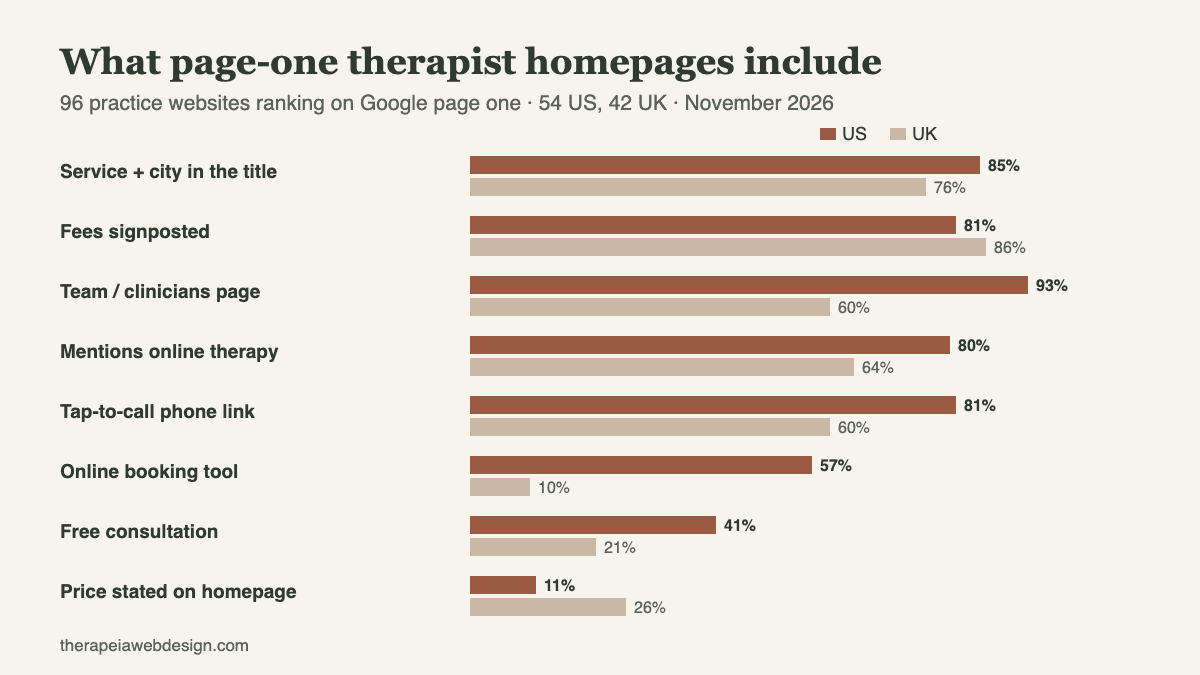
1. Your homepage competes with directories first
Before you compare yourself with other practices, it helps to know who else is on the page. Of the 255 organic first-page results we reviewed, 88 (35%) were directories, marketplaces or therapy platforms, and Psychology Today alone appeared for 27 of 28 searches. Practice websites took 101 results (40%), and the rest were NHS, university, charity, social and national-chain pages.
The practical takeaway: your homepage doesn't have to beat Psychology Today to win clients. It has to be the clearest practice result on the page, and be visible in the map results above it, which depend mostly on your Google Business Profile (see our Google Business Profile guide for therapists).
2. The title tag: service and city, about 58 characters
| Homepage title includes | All (96) | US (54) | UK (42) |
|---|---|---|---|
| City or local area | 86% | 91% | 81% |
| Therapy, therapist or counselling | 90% | 93% | 86% |
| Both | 81% | 85% | 76% |
The median homepage title is 58 characters long. A simple pattern covers it: [Service] in [City] | [Practice name], for example "Counselling in Leeds | [Practice name]" or "Couples Therapy in Austin | [Practice name]". If you offer several specialties, use the homepage for your main service and city, and give each specialty its own page. Our keywords for therapy service pages study shows the exact wording people search for each one.
3. The H1: say what you do
81% of ranking homepages have an H1 that names a service or condition (therapy, counselling, anxiety, trauma, couples and so on), and 56% include the city. Two-thirds (66%) use exactly one H1, while 29% have more than one, usually because of a theme setting rather than a deliberate choice. A clear H1 such as "Anxiety and trauma therapy in Denver" does more work than "Welcome" or a tagline on its own.
4. Make it easy to get in touch
| Contact and booking | All | US | UK |
|---|---|---|---|
| Click-to-call phone link | 72% | 81% | 60% |
| Clickable email link | 62% | 57% | 69% |
| Contact form on the homepage itself | 23% | 19% | 29% |
| Link to a contact page | 90% | 93% | 86% |
| Online booking or client-portal tool | 36% | 57% | 10% |
| "Book / schedule / request an appointment" call to action | 68% | 87% | 43% |
| Free consultation or free call | 32% | 41% | 21% |
Two patterns stand out. First, US practices lean heavily on online scheduling; SimplePractice is the most common tool. UK practices mostly ask people to call, email or use a contact page. Second, very few homepages carry the full contact form; most link to a dedicated page. Whichever you choose, make the next step visible near the top and repeat it lower down.
The only difference between top-three sites and the rest that came close to statistical significance was booking: 71% of top-three sites offered some way to book (a booking tool or their own appointments page) against 47% of sites ranking 4–10. With 28 top-three sites that's a hint, not proof, and it's at least as likely that busier, well-run practices both rank well and offer booking.
5. Fees and insurance: signpost them
| Fees and insurance on the homepage | All | US | UK |
|---|---|---|---|
| Any fees signal (wording or a link to fees, rates, insurance or payment) | 83% | 81% | 86% |
| States an actual price | 18% | 11% | 26% |
| Mentions insurance | 45% | 67% | 17% |
| Names a specific insurer | 21% | 31% | 7% |
| Mentions a sliding scale | 9% | 17% | 0% |
Most ranking practices don't put prices on the homepage, but almost all of them make fees easy to find. UK practices are more likely to show a price; US practices are more likely to talk about insurance and name the insurers they work with. Our guide to what to put on your therapy fees and insurance page covers the page that link should lead to.
6. Content and trust signals
- Length: the median homepage has about 1,140 visible words (US 1,226, UK 820); only 14% have fewer than 500.
- Team: 78% link to a team or clinicians page (93% US, 60% UK), so many of the practices that rank are group practices.
- Online therapy: 73% mention online, virtual or video sessions.
- Blog or resources: 84% link to one (96% US, 69% UK).
- FAQs: 26% have an FAQ section on the homepage and 60% link to an FAQ page.
- Psychology Today badge: only 8% show one, despite how often Psychology Today itself ranks.
7. Platforms: no single "right" builder
| Platform | All (96) | US (54) | UK (42) |
|---|---|---|---|
| WordPress | 48% | 43% | 55% |
| Wix | 17% | 15% | 19% |
| Squarespace | 17% | 24% | 7% |
| Custom-coded or other CMS | 9% | 9% | 10% |
| Showit | 4% | 7% | 0% |
| Other (Webflow, Framer, Google Sites, RapidWeaver) | 5% | 2% | 10% |
Ranking practices use the same mainstream builders as everyone else, and we found no sign of therapist-specific website platforms among them. The platform matters less than what's on the page. If you're choosing one, our website builder comparison for therapists covers the trade-offs.
8. Technical basics most sites get right, and a few they don't
- All 96 use HTTPS and 99% have a mobile viewport tag. 91% have a meta description.
- Only 46% have LocalBusiness-type structured data (LocalBusiness, MedicalBusiness, Psychologist and similar), which is an easy gap to close.
- 21% embed a Google map, and only 7% link to an accessibility statement.
9. You don't need a "strong" website to rank locally
The median Ahrefs Domain Rating among ranking practices is 19, and 52% are below 20. Even in the top three, 12 of the 28 sites score below 20. Local results reward relevance (the right service in the right city, clearly stated) far more than raw link authority.
A homepage outline based on the data
This is the order we'd use for a practice homepage, built from what most page-one sites include. It's a starting point, not a guarantee: the data shows what ranking sites have in common, not what makes them rank.
- Title tag: service and city, about 50–60 characters.
- H1: what you offer and where, for example "Couples therapy in Austin".
- One line on who you help, then a clear next step: a booking button, a tap-to-call number, or both.
- Services, each linking to its own page.
- Fees signpost: a price or a link to your fees page; in the US, the insurers you work with or out-of-network options.
- In person and online: say where you see clients and whether you offer video sessions.
- About you or your team, linking to clinician profiles.
- A short FAQ (first session, cost, availability), then the contact step again.
- Links to helpful articles and your contact page in the footer, with your practice name, area and phone number.
City-by-city results
The per-city samples are small (one to five practice sites per search), so treat them as a snapshot rather than a rule. They still show how much page one varies from city to city:
- Leeds: all 5 practice sites on page one for "therapist leeds" have a Domain Rating under 20.
- Bristol: the #1 result for "counselling bristol" has a Domain Rating of 2.
- Manchester: all 4 practice sites name the city in both the title and the H1; 3 of 4 have a Domain Rating of 3 or lower.
- London: 4 of 5 have a Domain Rating of 20 or more, and 3 of 5 state a session price on the homepage.
- Edinburgh and Glasgow: none of the 7 Scottish practice sites states a price on the homepage.
- New York: all 3 practice sites link to an online booking tool, and all have a Domain Rating between 33 and 40.
- Boston: the #4 result for "therapist boston" has a Domain Rating of 6.
- Los Angeles: both practice sites on page one have a Domain Rating under 20.
Each city page has the full breakdown. See all therapist website design locations.
How we did this
Searches: 28 searches, 15 in the US (therapist plus city for 13 cities, plus "couples therapist chicago" and "anxiety therapist austin") and 13 in the UK (therapist, psychotherapist, counsellor or counselling plus city). Results came from Ahrefs first-page snapshots dated 29 September to 11 November 2026. We used the first 10 organic results per search (255 in total), ignoring map packs and other search features.
Sample: we excluded directories, marketplaces and therapy platforms, NHS, government, university and hospital pages, charities and non-profits, social media and national chains, then reviewed each remaining site by hand. 8 sites blocked automated access and were left out. That left 96 independent and group practice websites (54 US, 42 UK), each counted once at its best position.
Measurement: we fetched each homepage on 11 November 2026 and measured it from the raw HTML, without running JavaScript, so features that load with JavaScript (some forms, analytics and cookie banners) are undercounted. Domain Rating comes from Ahrefs. Differences between groups were tested with Fisher's exact test; with 28 top-three sites, small differences aren't meaningful, and correlation is not causation. We don't name individual practices.
If you'd like a homepage built around this kind of evidence, see our website design for therapists, our website redesign service, or start from one of our therapist website templates.